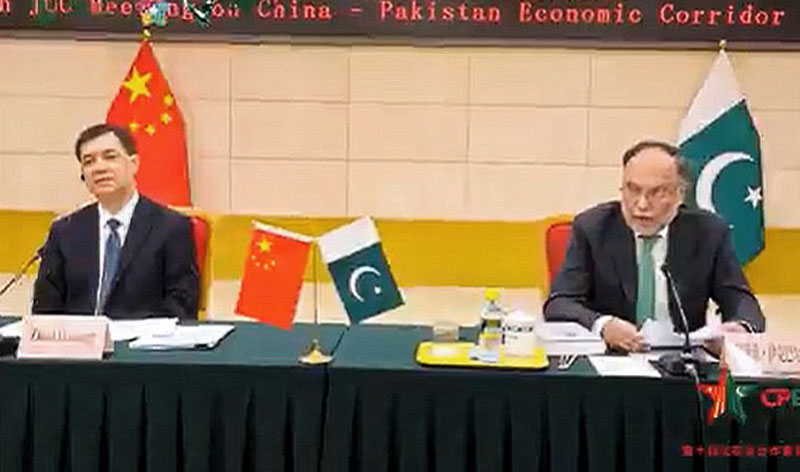
 Federal Minister for Planning, Development and Special Initiatives Professor Ahsan Iqbal on Friday expressed confidence that the China-Pakistan Economic Corridor (CPEC) Phase-II would serve as an engine of next-level regional connectivity and economic growth.
“Today’s deliberations confirm that CPEC Phase-II will be the engine that drives the next stage of our partnership and growth, aligning its five corridors – growth, innovation, green, livelihood, and regional connectivity – with Pakistan’s 5Es framework of exports, e-Pakistan, energy and environment, and equity and empowerment,” he said.
He was delivering closing remarks at the 14th meeting of the Joint Cooperation Committee (JCC) of CPEC, co-chaired with Chairman of China’s National Development and Reform Commission (NDRC) Zheng Shanjie. The minister said the session had reaffirmed the two countries’ shared vision and set an ambitious roadmap for Phase-II. The meeting was attended by ministers, senior officials, line ministries and experts from both sides. Ahsan Iqbal, who has co-chaired 11 of the 14 JCC meetings so far, said he had witnessed CPEC’s evolution “from an idea on paper into a monumental reality.”
“We have agreed to transform CPEC into a corridor of industrialization, technology, sustainability and shared prosperity,” he said, adding that this convergence was anchored in an action plan signed during Prime Minister Shehbaz Sharif’s visit and reinforced through understandings with President Xi Jinping and Premier Li in September 2025. “That plan, together with today’s consensus, lays out a comprehensive agenda covering industrial cooperation, special economic zones, modern agriculture, maritime development, mining, technology and major connectivity projects such as ML-1, KKH and Gwadar,” he said.
He added that CPEC 2.0 would create real opportunities for youth, researchers, entrepreneurs and workers, while stressing the urgency of the Main Line-1 railway project and the realignment of the Karakoram Highway (KKH). “The KKH realignment necessitated by a major hydropower dam will preserve uninterrupted connectivity between our nations,” he noted. To sustain momentum, the minister proposed holding JCC meetings every six months and convening joint working groups quarterly for the first three years, as practiced during Phase-I. “This will ensure CPEC 2.0 advances in the spirit envisaged by our leaders,” he added.
Ahsan Iqbal assured Chinese partners of Pakistan’s absolute commitment to ensuring the safety and security of all CPEC projects and every Chinese national working in the country. “We will continue to provide the stable, secure and enabling environment this partnership deserves,” he said.
“Together, with renewed determination and shared vision, we will ensure that the next decade of CPEC brings even greater transformation than the last,” the minister said, proposing to hold the 15th JCC meeting in May 2026 in Islamabad as part of the 75th anniversary celebrations of diplomatic relations between the two countries.
Earlier, in his opening remarks, the planning minister highlighted achievements of CPEC Phase-I, noting that 17 major energy projects with a combined capacity of over 8,000 MW and worth nearly $18 billion had ended crippling power shortages in Pakistan. These projects, he said, enabled the country to harness Thar coal and diversify its energy mix into hydropower and renewable sources.
On connectivity, he said more than 888 kilometers of modern highways had been built, knitting regions into a single economic space. He thanked the Chinese leadership for confirming 85 percent financing for the Thakot Dry Port-KKH realignment, necessitated by sections of the road being submerged after the completion of a major dam. “This alignment must be completed by 2028. We propose initiating the bidding process immediately while the financing agreement is finalized,” he added.
On railways, Ahsan Iqbal said modernization of the Main Line-1 (ML-1) from Karachi to Peshawar was vital. He proposed a blended financing model, with the Multan-Rohri section supported by the Asian Infrastructure Investment Bank (AIIB) and the Karachi-Rohri section by the Asian Development Bank (ADB), to accelerate implementation.
He said Gwadar had transformed from a quiet fishing town into Pakistan’s maritime gateway under CPEC. With Chinese grant support, the port city now hosts an international airport, hospital, vocational center, desalination plants and solar facilities. “The next step is to market Gwadar as a regional logistics hub serving Central Asia and the Gulf, with COSCO playing a leading role. During my recent visit to COSCO headquarters in Shanghai, I held very good discussions with its management in this regard,” he added. “These are not merely projects; they are milestones of trust, confidence and shared progress,” he remarked, adding that Phase-II must raise the edifice of high-quality, inclusive and sustainable growth, aligned with Pakistan’s 5Es framework and CPEC 2.0’s five corridors.
The roadmap for a people-centric future, he said, must revolve around three key elements, with youth at the core of transformation. “Nearly 60 percent of Pakistan’s population is under 30 years of age,” he noted, proposing 10,000 PhD joint scholarships in AI, engineering and emerging sciences at China’s top 50 universities over the next decade to build a critical human resource base for knowledge-driven growth. He also suggested bringing China’s research-based innovation ecosystem to Pakistan.