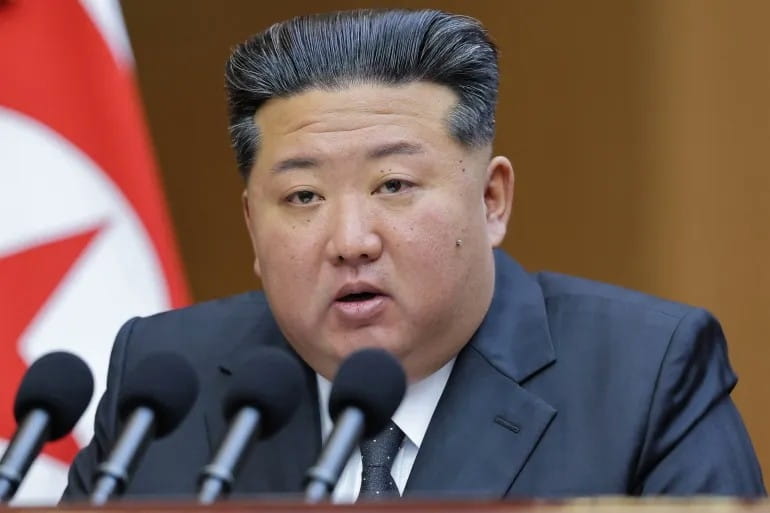
North Korean leader Kim Jong Un announced that he is willing to hold talks with the United States if Washington abandons its demand for denuclearisation, stressing he will never surrender his nuclear arsenal to ease sanctions. Speaking at the Supreme People’s Assembly, Kim recalled his previous meetings with former US President Donald Trump, noting his “fond memories” and suggesting he could meet Trump again if conditions change. His remarks signal a possible opening amid years of stalled negotiations.
Read more : US-China trade talks resume in Madrid amid tensions –
Kim’s comments came as the liberal government in Seoul encouraged Trump to re-engage Pyongyang, six years after peace talks collapsed over sanctions and disarmament disputes. He criticised joint US-South Korean military exercises, claiming they have evolved into preparations for nuclear war and reaffirmed that nuclear weapons remain essential for North Korea’s survival. By contrasting warm words for Trump with hostility toward South Korea, Kim sent a clear message about his preferred diplomatic channels.
Highlighting ongoing tensions, Kim rejected any phased disarmament plan proposed by South Korean President Lee Jae Myung, arguing that recent offers for dialogue are insincere and still aimed at weakening his regime. He warned that North Korea has learned from past international experiences, asserting that surrendering nuclear capabilities would leave his country vulnerable. His blunt refusal of incremental negotiations underlined Pyongyang’s distrust of Washington’s intentions and Seoul’s involvement in nuclear discussions.
Meanwhile, South Korea’s President Lee expressed concern over North Korea’s growing capabilities, stating that Pyongyang could be producing 15 to 20 nuclear bombs each year. He suggested that freezing bomb production could serve as a first step toward reductions and eventual disarmament. Lee emphasised that mutual trust and addressing regime-security concerns would be necessary for any long-term denuclearisation process, urging efforts to create the right environment for meaningful dialogue.
Kim acknowledged that sanctions imposed since North Korea’s first nuclear test in 2006 had pressured his country but argued they had strengthened its resilience and determination. Observers believe his comments aim to bypass South Korea and directly influence US policy, potentially reshaping diplomatic dynamics. As tensions remain high, Kim’s conditional openness underscores both the fragility and potential of future negotiations in addressing one of the world’s most persistent security challenges.