I was born in Sukkur, a city where history, culture, and engineering intertwined. To the world, it may appear provincial, but to those of us who grew up there, Sukkur was a miniature cosmos — a city of barrages and bridges, of clubs and libraries, of rivers and Algoza music, and of blind dolphins that existed nowhere else on Earth.
A City of Learning and Culture As a schoolboy at St. Mary’s, I wandered often from the classrooms to Lucas Park, to Sadhu Bela’s mystical island, and to the banks of the Indus at Manzilgarh. But Sukkur was not only about the river; it was a city of letters.
The General Library of Sukkur, founded in the 1800s, was one of the oldest libraries of Sindh. Alongside institutions like St. Marsavius and Sewell’s, it anchored Sukkur’s identity as a well-developed town long before partition.
For us children, books, music, and memory formed a triad of discovery. The cultural life was rich. The colour clubs were where elites gathered, while the Algoza flute echoed through festivals and shrines. Even as the trains came across the river, carried first by ferries before the great bridges were completed, Sukkur pulsed with an artistic rhythm.
A City of Engineering Wonders No child of Sukkur could ignore the marvels of engineering. The Lansdowne Bridge, completed in 1889, was at its time the longest rigid girder bridge in the world. Its steel was forged in Manchester, shipped to Sindh, and assembled under Burghardt’s eye. For decades, it carried trains across the Indus — locomotives that once had to be ferried by boat.
To a boy’s imagination, it was a world wonder. Then came the Lloyd Barrage, completed in 1932, one of the greatest irrigation works of its era. It was built to solve Sindh’s recurring famines, caused by the seasonal flow of the Indus.
For the first time, perennial irrigation brought water year-round. Seven great canals — the Nara, Rice, Dadu, Khairpur Feeder, Rohri, and others — fanned out from its gates, irrigating more than seven million acres. The barrage was called a wonder of the world, and rightly so.
It not only stopped famine but laid the foundations of Sindh’s agricultural economy. A City of Geopolitics and Railways Sukkur was not isolated. It stood at the crossroads of empire. The Bolan Pass and the Khyber Pass were the only two true gateways across the Hindu Kush into India, with the Himalayas forming a barrier elsewhere.
These passes shaped history: invaders came through them, and the British secured them to contain threats. The annexation of Kalat and the building of cantonments in Quetta were part of this strategy. The railway connected Sukkur to this grand chessboard. Bridges over the Indus linked to lines running toward Quetta and the Bolan.
The Lansdowne Bridge itself was part of the Great Game — enabling imperial armies to move westward. For a boy sitting on the riverbank, watching trains cross, it was history unfolding in steel.
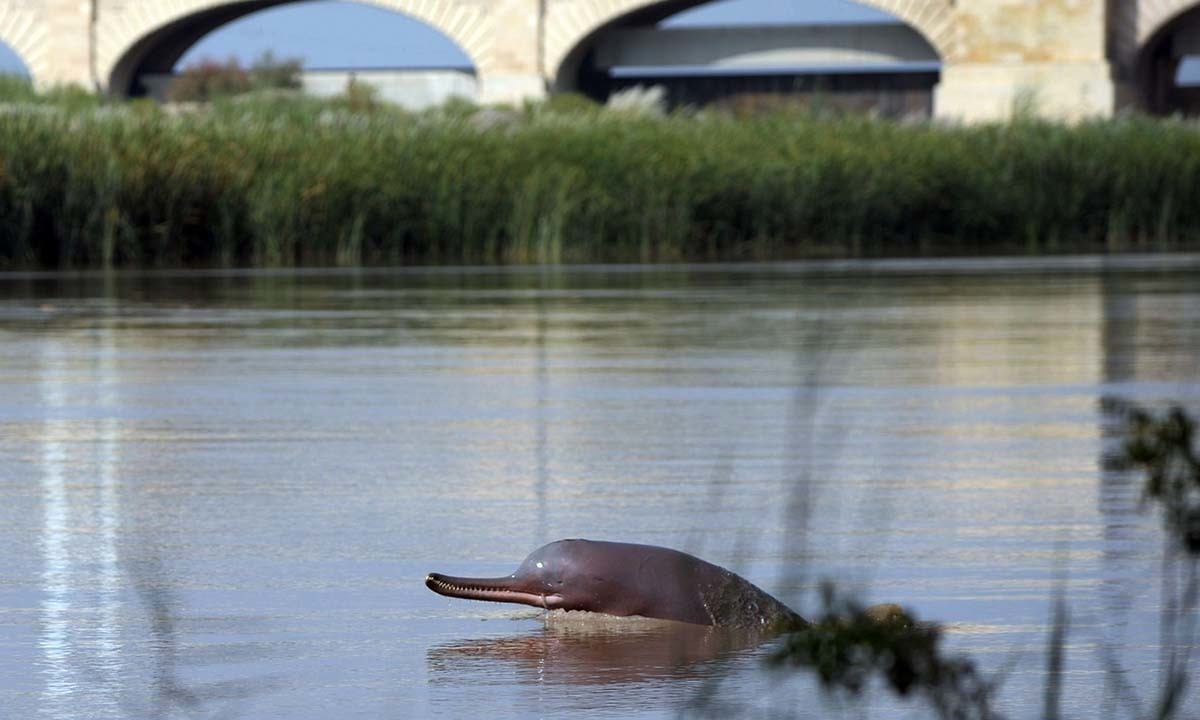
A City of Dolphins and Wonder And then there were the dolphins. The Indus blind dolphin (Platanista gangetica minor) lives nowhere else in the world. Endemic to Pakistan, it is found in greatest numbers between the Lloyd Barrage at Sukkur and the Guddu Barrage upstream. In my childhood of the 1960s, they were nearly gone.
Once in a great while, at Lab-e-Mehran, we would glimpse one. The joy was indescribable. These were the rarest of beings, surviving in a shrinking river. By the 1970s, only around 150 remained. I thought they would vanish forever.
But conservation in 1974 created the Indus Dolphin Reserve. Against all odds, the population rebounded. Today, more than 1,800 survive, most of them between Sukkur and Guddu.
When I return and see pods leaping again, I see proof that nature, when given a chance, can heal. Philosophy of Water and Bridges Looking back, I see Sukkur as my teacher. The barrages taught me that water is life — that famine could be stopped by harnessing the perennial flow of a river.
The bridges taught me that connectivity is survival — that societies progress when they build links, not walls. And the dolphins taught me that inclusion is strength — that what seems lost can live again if protected.
My life carried me far, to Paris with its bridges over the Seine, and to Manchester where the girders of my childhood bridge were forged. Yet Sukkur is always in my blood. It was a city of barrages and bridges, libraries and clubs, myths and marvels. It was where history and childhood met, and where even blind dolphins could dance again in the current.