
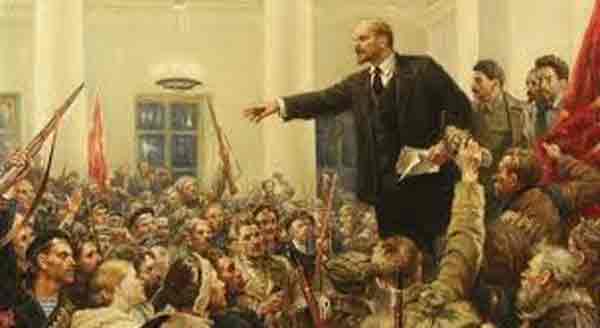
Lest we forget, the Russian Revolution led by the Bolsheviks under Vladimir Ilywich Lenin was one of the greatest events of the last century.
The French Revolution (1789) transformed the world and set in motion processes which to this day are at the core of the notion of citizenship and individual rights.
The Russian Revolution is that turning point in history when more than 2000 years of philosophy, history and culture based on the notion of some natural inequality among human beings was called into question and thus began a movement aiming to challenge all social and political orders that are based on the right of the privileged to rule over others.
The origins of the Russian revolution, its connection with Marxism and the practice of its state are subjects of continuing controversy.
Did Lenin and his comrades correctly interpret Karl Marx and Friedrich Engels in making a revolution on the periphery of Western Capitalism — Czarist Russia?
Was the state which Lenin established and Stalin consolidated a correct application of Marxist theory?
Would the Russian Revolution fare better if Trotsky had succeeded Lenin? Why did Communism fail in Russia? I shall not go into these questions but only note what I think has been the historical impact of that Revolution.
The Russian Revolution carried out by Lenin and consolidated by Stalin transformed Russia from a largely bureaucratic empire of peasants into an industrial giant and became the centre of an international movement against colonialism and unbridled capitalism.
It began a movement aiming to challenge all social and political orders that are based on the right of the privileged to rule over others
It is widely noted that in Western Europe conservative and other governments started welfare initiatives to forestall their workers opting for the revolution.
Marxism was interpreted in a revolutionary manner by Lenin and in a democratic manner by the German theorist Bernstein. The followers of Benstein invested in the democratic and parliamentary way to build a welfare state which combined substantive equality with substantive freedom. In Scandinavia, especially Sweden, the latter type of socialist movement emerged and created Social-Democratic welfare states.
The Union of Soviet Socialist Republic (USSR) eliminated poverty, established free medicine and highly subsidised housing, free education and job security.
It became a model for others to emulate and Marxism-Leninism became the battle cry of oppressed classes all over the world. There is hardly any third world society which did not have intellectuals converting to Communism and an international movement for socialism came into being.
The Chinese Revolution of 1949 and the liberation struggles of Vietnam and other Southeast Asian countries were examples of the international attraction of Communism.
However, a major flaw in Marxism and subsequently in Leninism has been to assume that once the workers or their party captures power somehow the state is transformed into a organisation only serving the interests of the people.
The state remains always a power instrument and it must be kept under control through checks and balances. In this regard the Western democratic theory of the state is more realistic. Therefore, the democratic state has survived and developed through a system of multiple controls including an open society, rule of the law and free press and thus self-correction and reform.
The Soviet Union ultimately become too bureaucratic, with extreme organisation of the economy and with strict limits on the freedoms of individuals to write and publish and there was no political opposition to challenge the policies of the government.
It over-spent itself economically and therefore its economy was greatly weakened. Such weaknesses resulted in the disintegration of the Soviet Union in 1991. It broke my heart but made me more realistic about what is possible and what is not.
During 1917-1991 the Soviet Union played many positive roles and helped national liberation movements. It also established and practised a welfare system of great generosity.
It is a pity that Putin and his ilk did not celebrate the Russian revolution but I am sure among the older citizens of that country there are many who remember it with deep nostalgia and sadness.
The writer is Professor Emeritus of Political Science, Stockholm University; Visiting Professor Government College University; and Honorary Senior Fellow, Institute of South Asian Studies, National University of Singapore. He can be reached [email protected]
Published in Daily Times, November 8th 2017.