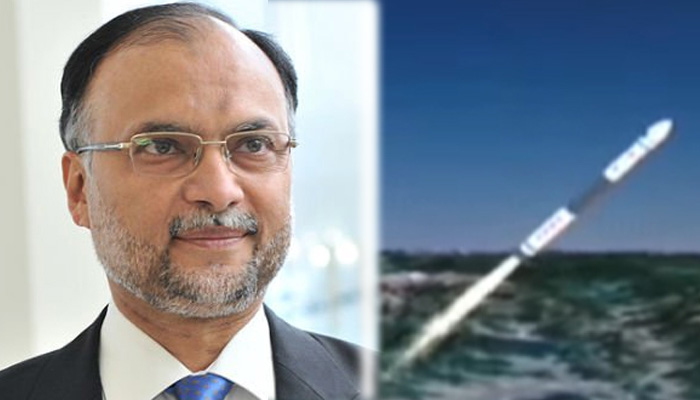
Federal Planning Minister Ahsan Iqbal has congratulated the nation on the successful launch of Pakistan’s latest remote sensing satellite. Speaking after the launch, he praised the entire SUPARCO team, including engineers and scientists, and thanked China for its strong technical support in the mission.
Iqbal confirmed that the satellite had successfully reached its orbit and marked another step forward in Pakistan’s journey into space technology. “We are committed to restoring Pakistan’s leadership in space science,” he said, adding that a Pakistani astronaut would be sent into space next year with China’s assistance.
Looking ahead, the minister shared an ambitious goal: “By 2035, we will successfully complete our program to reach the Moon.” This statement reflects the government’s growing focus on advancing its space capabilities in both scientific and strategic domains.
With the latest launch, Pakistan has now sent a total of four remote sensing satellites into space. These satellites are vital for monitoring environmental issues like floods, glacier movements, and water flow, and can play a crucial role in disaster early warning systems.
Experts say the data from these satellites will help authorities plan better responses to climate-related threats and manage natural resources more efficiently. Pakistan’s expanding space program represents a blend of ambition, innovation, and international cooperation—particularly with China—as it looks toward the stars.