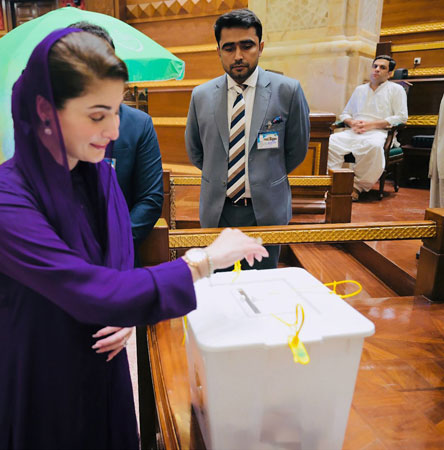
 The seat-adjustment arrangement between the Khyber Pakhtunkhwa government and opposition arrangement came through in the Senate elections in the province on Monday – with the treasury winning six and the opposition bagging five seats, according to unofficial results.
The treasury and the joint opposition alliance had agreed on a seat-sharing formula under which six seats would go to the treasury, which has 92 members in the KP Assembly, and five seats to the opposition, which is 53-strong.
On Sunday, it emerged that what initially shaped up to be a three-way contest – among PTI, PTI “dissidents” and opposition lawmakers – turned out to be almost a two-way match after the size of PTI’s “disgruntled” faction was effectively reduced to just one candidate.
PTI’s Murad Saeed, Faisal Javed, Mirza Afridi and Noorul Haq Qadri were elected as senators on general seats, according to the unofficial results.
Murad Saeed received 26 votes, Mirza Afridi and Faisal Javed both bagged 22, and Noor-ul-Haq Qadri 21.
PTI’s Azam Swati was elected on a technocrat seat with 89 votes. Similarly, PTI’s Rubina Naz became a senator on a women’s seat with 89 votes.
Federal Minister for Gilgit Baltistan and Kashmir Affairs and States and Frontier Regions Amir Muqam’s son Niaz Ahmed reached the upper house by with 18 votes on a general seat.
PPP’s Talha Mehmood bagged a Senate seat with 18 votes. PPP’s Rubina Khalid was elected as a senator on women’s seat with 52 votes.
JUI-F’s Attaul Haq won on a general seat and the party’s Dilawar Khan on a technocrat seat to become members of the upper house with 18 and 54 votes, respectively.
On Sunday, twenty-five MPAs-elect of the KP opposition were sworn into office after KP Governor Faisal Karim Kundi administered their oaths.
The oath-taking issue has risen once again after the recent redistribution of reserved seats in the wake of a verdict by the Supreme Court’s constitutional bench that effectively took away the seats from the PTI and declared other political parties eligible for them.
Currently, the ruling coalition has 54 members in the 96-member Senate – 10 short of the two-thirds majority (64 seats).
A separate election for the seat vacated by Senator Sania Nishtar is scheduled for July 31.
The by-election on a vacant Senate seat in Punjab was won by PML-N’s Hafiz Abdul Kareem with 243 votes, according to official results from the ECP.
The PML-N had nominated the emir of the Markazi Jamiat Ahle Hadith, as its candidate for the seat, which fell vacant after the demise of Professor Mir.
The total available votes were 368, with 345 polled votes, of which valid votes were 342, while three were rejected.
In a speech after his victory, Kareem thanked God and mentioned that he was grateful to PML-N leader Nawaz Sharif and Prime Minister Shehbaz Sharif
“I thank Mian Nawaz Sharif, who always remained loyal to Jamiat Ahle Hadith,” Kareem said.
He added that he was also deeply grateful to Punjab Chief Minister Maryam Nawaz, whom he credited for his victory.
“She left work in the flood-affected areas and cast her vote for me,” Kareem said.
Separately, Khyber Pakthunkhwa Chief Minister (CM) and Speaker Provincial Assembly, here Monday challenged the oath taking of newly elected members of the reserved seats in the Peshawar High Court.
The oath of new MPAs elected on reserved seats has been challenged in the Peshawar High Court (PHC) by Chief Minister Ali Amin Gandapur and Speaker Babar Saleem Swati.
The write petition comes a day after KP Governor Faisal Karim Kundi administered the oath to 25 opposition’s reserved seats MPAs including 21 women and four minority members in compliance with the orders of Peshawar High Court.
The opposition MPAs had approached PHC, urging the chief justice to nominate an authority to oversee the oath-taking process after KP Assembly speaker adjourned the session due to a lack of quorum on Sunday last.
The KP governor, federal government, PHC registrar and ECP were made parties in the case. The plea maintained that the KP assembly session had commenced on Sunday but was adjourned by the speaker due to the lack of quorum.
The post-election landscape has also seen a notable shift in party standings within the Senate. The Pakistan Peoples Party (PPP) has emerged as the single largest party, commanding a robust presence with 26 senators. This represents a considerable gain for the PPP, positioning it at the forefront of the Senate’s political dynamics.