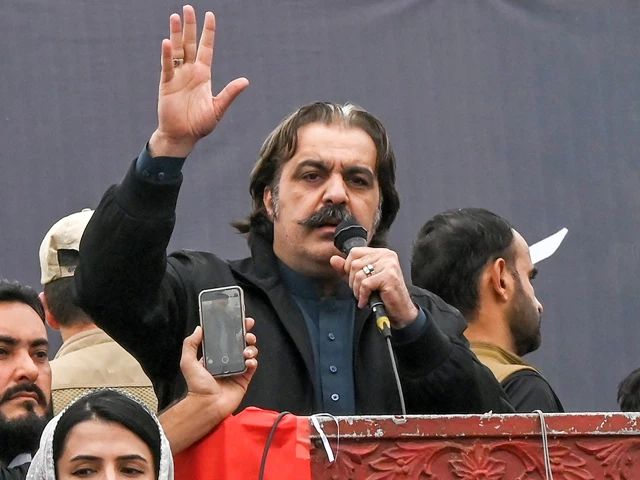
In a major legal development, a judicial magistrate in Islamabad has issued non-bailable arrest warrants for Khyber Pakhtunkhwa Chief Minister Ali Amin Gandapur. The action comes after Gandapur failed to appear in court and sought exemption in a nearly eight-year-old criminal case related to the alleged recovery of illegal arms and liquor.
Judicial Magistrate Mubashir Hassan Chishti ordered the local Station House Officer (SHO) to arrest the chief minister and ensure his appearance before the court at the next hearing on July 21. The court also served a compliance notice to the SHO for immediate execution of the order.
The case dates back to October 2016, when Islamabad police claimed to have intercepted a vehicle near Bani Gala, allegedly linked to Gandapur. According to the police, the vehicle contained five Kalashnikov rifles, a pistol, six magazines, a bulletproof vest, a bottle of liquor, and three tear gas shells.
Gandapur has consistently rejected these accusations, stating that he was carrying only two licensed rifles and that the liquor bottle reportedly found by police actually contained honey. He also claimed that all arms were legally documented and their licenses were available in the car.
The court observed that the prosecution had completed witness testimonies in May 2024, but the accused failed to record his statement under Section 342 of the Criminal Procedure Code. The magistrate said the court had given “ample opportunity” to the accused, and no more relief would be granted if he fails to comply this time.
Interestingly, the magistrate clarified that Gandapur’s bail—granted earlier by the Peshawar High Court—does not apply to this particular case, thus giving the trial court full authority to act independently.
If Gandapur fails to appear at the July 21 hearing, the court warned it may proceed to announce a verdict in his absence.
The case resurfaces at a politically sensitive time, with Gandapur holding a key provincial position and the PTI party already under pressure on several legal and electoral fronts.