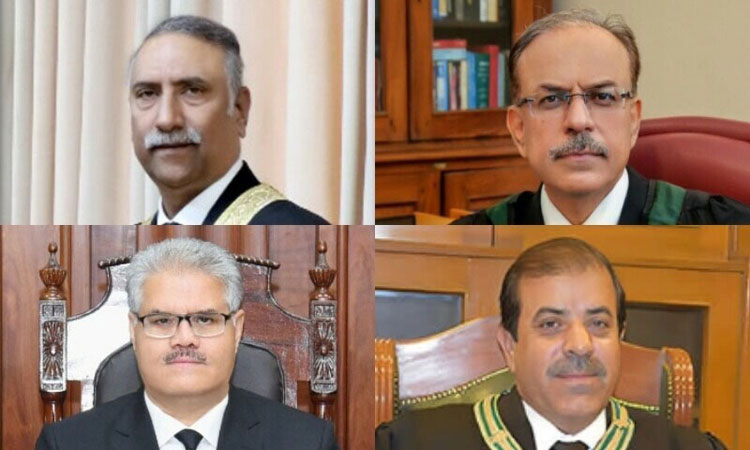
 The Judicial Commission of Pakistan (JCP) on Tuesday appointed the chief justices to the four high courts, a statement issued by the Supreme Court said.
Per the statement, the JCP held four consecutive meetings to make a decision related to the appointments and, by a majority of its total membership in each meeting, opted to allow the acting chief justices to continue serving the top roles.
Letters were subsequently issued to the prime minister’s principal secretary, informing the government about the nominations and requesting the forwarding of the same to the president for their appointment.
The letters said that Justice Sarfraz Dogar was nominated as the new chief justice of the Islamabad High Court (IHC), Justice Rozi Khan Barrech as the chief justice for the Balochistan High Court (BHC), Justice Syed Muhammad Attique Shah for the Peshawar High Court, and Justice Junaid Ghaffar for the Sindh High Court (SHC).
President Asif Ali Zardari on Saturday had already formally declared Justice Dogar the “senior-most judge” of the IHC, following the issuance of a revised seniority list by the Ministry of Law and Justice.
The development followed a ruling by the Supreme Court on June 19, upholding the constitutionality of transferring three judges from other provincial high courts and referring the matter of seniority determination to the president.
On Friday, five IHC judges had challenged the Supreme Court’s decision to uphold the transfer of three judges – Justice Dogar from the LHC, Justice Khadim Hussain Soomro from the SHC, and Justice Muhammad Asif from the BHC.
President Zardari had also declared that the status of the transfer of all three judges would be permanent.
Separately, the Peshawar High Court (PHC) has issued a stay order, temporarily barring newly selected members on reserved seats from taking oath in the provincial assembly.
A two-member bench comprising Justice Syed Arshad Ali and Justice Dr. Khurshid Iqbal heard the petition filed by Pakistan Tehreek-e-Insaf Parliamentarians (PTI-P) challenging the allocation of reserved seats.
The petitioner’s counsel, Advocate Sultan Muhammad Khan, argued that the Election Commission miscalculated the allocation of reserved seats, stating that PTI-P, which held two general seats in the provincial assembly, was wrongfully granted only one women’s reserved seat.
When questioned by the bench, the lawyer confirmed that PTI-P had submitted its priority list for the reserved seats. He further maintained that PTI-P was entitled to two women’s seats and one minority seat. The petitioner requested that the oath-taking of members on these disputed reserved seats be halted. In response, the court issued notices to the Election Commission and directed that no oath be administered to the concerned members until the next hearing.