
In Syria and Iraq, there is actually a three-way ethnic and sectarian conflict between Sunni Arab militants, Shi’a Arab governments and the Kurds. Although after the declaration of war against a faction of Sunni Arab militants, the Islamic State, the US has also lent its support to the Shi’a-led government in Iraq, but the Shi’a Arabs of Iraq are not trustworthy allies of Washington because they are under Iranian influence
For simplification’s sake the Syrian theatre of proxy wars can be divided into three separate and distinct zones of influence. These are the Syrian government-controlled areas, the regions administered by the Syrian Kurds and the areas occupied by the Syrian opposition.
Excluding Idlib in north-western Syria, which has been occupied by the Syrian opposition, all the major population centres along the western Mediterranean coast are controlled by the Syrian government. These include Damascus, Homs and Aleppo, while the oil-rich Deir al-Zor has been contested between the Syrian government and the Islamic State (IS).
The regions administered by the Syrian Kurds include Qamishli and al-Hasakah in north-eastern Syria, Kobani along the Turkish border and a small territorial district in north-western Syria, Afrin.
Excluding the western Mediterranean coast and the adjoining major urban centres controlled by the Syrian government and the Kurdish-administered areas in the north of Syria along the borders with Iraq and Turkey, the Syrian opposition-controlled areas can be further subdivided into three separate zones of influence; firstly, the northern and north-western zone along the Syria-Turkey border, in and around Aleppo and Idlib, which is under the influence of Turkey and Qatar. Both these countries share the ideology of Muslim Brotherhood and provide money, training and arms to Sunni Arab militant organisations, such as al-Tawhid Brigade, Zenki Brigade and Ahrar al-Sham in the training camps located in the border regions between Turkey and northern Syria in collaboration with the CIA’s MOM, which is a Turkish acronym for military operations centre.
The allies of the US tend to assume that they are negotiating from a position of strength with the weight of a global power behind them. Under this mistaken assumption, they overreach and encroach upon the rights of their regional adversaries
Secondly, the southern zone of influence along the Syria-Jordan border, in Daraa and Quneitra and as far away as Homs and Damascus. It is controlled by the Salafist Saudi-Jordanian camp and it provides money, weapons and training to the Salafist militant groups such as al-Nusra Front and the Southern Front of the so-called ‘moderate’ Free Syria Army (FSA) in Daraa and Quneitra, and Jaysh al-Islam in the suburbs of Damascus. Their military strategy is directed by a Military Operations Centre (MOC) and training camps located in the border regions between Jordan and southern Syria.
Here, let me clarify that this distinction overlaps quite a bit and is heuristic at best, because al-Nusra’s jihadists have taken part in battles as far away as Idlib and Aleppo, and pockets of opposition-held areas can be found even in the Syrian government-controlled cities, including in the capital, Damascus. Thirdly, the eastern zone of influence along the Syria-Iraq border in Raqqa and Deir al-Zor, which has been contested between IS and the Kurdish-led Syrian Democratic Forces (SDF) in Raqqa. Here the jihadists have recently been routed from Deir al-Zor and Mayadeen by the Syrian government troops and allied Shi’a militias.
Thus, leaving the Mediterranean coast and Syria’s border with Lebanon, the Baathist and Shi’a-dominated Syrian regime has been surrounded from all three sides by hostile Sunni forces; Turkey and the Muslim Brotherhood in the north, Jordan and the Salafists of the Gulf Arab States in the south and the Sunni Arab-majority regions of Mosul and Anbar in Iraq in the east.
More to the point, the ethnic and sectarian conflict in Syria and Iraq is actually a three-way conflict between the Sunni Arab militants, the Shi’a Arab governments and the Kurds. Although after the declaration of war against a faction of Sunni Arab militants, the Islamic State, the US has also lent its support to the Shi’a-led government in Iraq, but the Shi’a Arabs of Iraq are not the trustworthy allies of Washington because they are under the influence of Iran.
In August 2014, the US declared a war against one faction of the Sunni Arab militants, IS, when the latter overran Mosul and Anbar in early 2014, and Washington made a volte-face on its previous ‘regime change’ policy and started conducting air strikes against IS in Iraq and Syria, thus shifting the goalposts in Syria from the previous unrealistic objective of ‘regime change’ to the achievable goal of defeating IS in order to save its credibility as a global power
Therefore, the US was left with no other choice but to make the Kurds the centrepiece of its policy in Syria after a group of Sunni Arab jihadists overstepped their mandate in Syria and overran Mosul and Anbar in Iraq in early 2014, from where the United States had withdrawn its troops only a couple of years ago in December 2011.
The so-called ‘Syrian Democratic Forces,’ which have recently liberated the de facto IS capital, Raqqa, are nothing more than Kurdish militias with a token presence of mercenary Arab tribesmen in order to make them seem more representative and inclusive in outlook.
Regarding the Kurdish factor in the Syrian civil war, it would be pertinent to mention here that unlike the pro-US Iraqi Kurds led by Masoud Barzani, the Syrian PYD/YPG Kurds as well as the Syrian government have been ideologically aligned, because both are socialists and have traditionally been in the Russian sphere of influence.
Moreover, as I have already described that the Syrian civil war is actually a three-way conflict between the Sunni Arab militants, the Shi’a-dominated regime and the Syrian Kurds, the net beneficiaries of this conflict have been the Syrian Kurds who have expanded their areas of control by aligning themselves first with the Syrian regime against the Sunni Arab militants since the beginning of the Syrian civil war in August 2011 to August 2014. This was back when the US policy in Syria was ‘change’ and the CIA was indiscriminately training and arming Sunni Arab militants against the Shi’a-dominated regime in the border regions of Turkey and Jordan with the help of Washington’s regional allies; Turkey, Jordan, Saudi Arabia and the Gulf states all of which belong to the Sunni denomination.
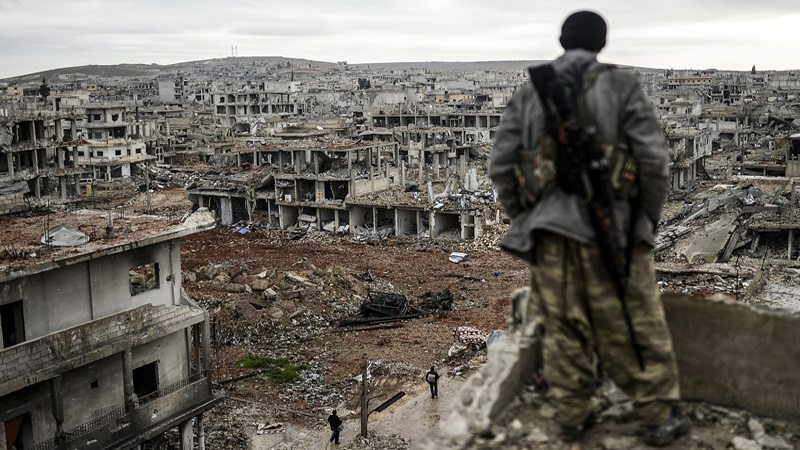
However in August 2014 the US declared a war against one faction of the Sunni Arab militants, IS, when the latter overran Mosul and Anbar in early 2014, and Washington made a volte-face on its previous ‘regime change’ policy and started conducting air strikes against IS in Iraq and Syria, thus shifting the goalposts in Syria from the previous unrealistic objective of ‘regime change’ to the achievable goal of defeating IS in order to save its credibility as a global power.
Regardless, after that reversal of policy by Washington, the Syrian Kurds took advantage of the opportunity and struck an alliance with the US against IS at Masoud Barzani’s bidding, hence further buttressing their position against the Sunni Arab militants as well as the Syrian government.
More to the point, for the first three years of the Syrian civil war from August 2011 to August 2014, an informal pact existed between the Syrian government and the Syrian Kurds against the onslaught of the Sunni Arab militants, until the Kurds broke off that arrangement to become the centrepiece of Washington’s policy in the region.
In accordance with the aforementioned pact, the Syrian government informally acknowledged Kurdish autonomy; in return, the Kurdish militias jointly defended the Kurdish-majority areas in north-eastern Syria, specifically al-Hasakah, alongside the Syrian government troops against the advancing Sunni Arab militant groups, particularly IS.
Finally, everyone has their own axe to grind in Syria, as there are no permanent allies or foes in international politics, only interests are permanent. It’s all about maintaining the balance of power, but whenever the US throws its weight behind a faction, it invariably disrupts the delicate equilibrium.
The allies of the US then tend to assume that they are negotiating from a position of strength with the weight of a global power behind them. Under this mistaken assumption, they overreach and encroach upon the rights of their regional adversaries.
This is exactly what has happened in Iraq and Syria. After securing Kurdish majority areas, the US-backed Kurdish militias overran Arab majority regions in northern Syria and Iraq, though some of those areas in northern Iraq have recently been retaken by Iraqi troops, including the oil-rich Kirkuk.
The writer is an Islamabad-based attorney, columnist and geopolitical analyst focused on the politics of Af-Pak and Middle East regions, neocolonialism and petro-imperialism
Published in Daily Times, October 25th 2017.