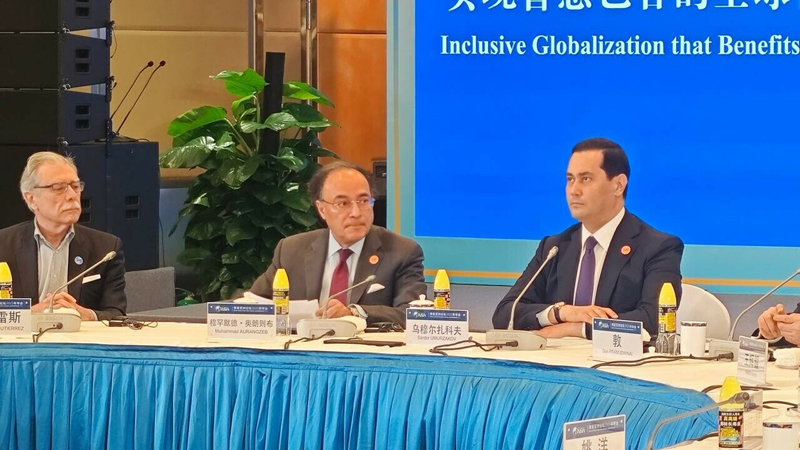
 Finance Minister Muhammad Aurangzeb has called for reforms in international financial institutions to better address the debt crisis in emerging economies like Pakistan.
Speaking at a high-level session at the Boao Forum for Asia Annual Conference 2025 in China, the finance minister stressed the need for debt relief and financial justice through restructuring sovereign debt mechanisms to prevent cyclical debt crises.
He said debt crises are impeding the economic growth of many emerging economies, including Pakistan, read a statement released by the Finance Division on Wednesday.
Noting that the global debt has soared past $100 trillion, with over 60% of low-income countries at risk of debt distress, Aurangzeb called for reforms in international financial institutions to offer developing economies greater financial flexibility and sustainable debt relief mechanisms.
He also called for reforms in the global financial architecture, including the enhancement of Special Drawing Rights (SDRs) allocations and the promotion of green bonds and blended finance models to attract private-sector investment in emerging markets.
Highlighting the growing inequalities within the global economic system, Aurangzeb noted that while globalization remains fundamentally unequal, disproportionately benefits developed economies while marginalizing the Global South.
“Pakistan, like many developing nations, advocates for a more balanced model of globalization—one that promotes fair trade, sustainable growth, and equitable financial systems. This model must be multilateral, innovation-driven, and inclusive, to foster development and prosperity across all regions,” Aurangzeb said.
The finance minister noted that a widening wealth and opportunity gap are among the key challenges facing inclusive globalization.
“Developed nations continue to gain from high-tech sectors, digital trade, and broad financial access while developing nations are held back by high tariffs, restrictive investment policies, and limited infrastructure.
“In response, Pakistan has consistently called for greater regional connectivity, fairer market access, and stronger multilateral cooperation, citing initiatives like the China-Pakistan Economic Corridor (CPEC) and the Special Investment Facilitation Council (SIFC) as steps in the right direction,” he said.
During his address, Aurangzeb also called for a global coalition among developing nations to collectively demand fairer trade rules and greater representation in international financial institutions.
He pointed out that Pakistan’s textile and agricultural sectors face significant challenges due to protectionist policies in developed countries and non-tariff barriers that limit their access to Western markets. On climate change, Aurangzeb highlighted that developing nations contribute less than 10% of global carbon emissions yet suffer disproportionately from the consequences of climate disasters. “Pakistan, despite contributing less than 1% of global carbon emissions, is one of the world’s most climate-vulnerable countries. Pakistan continues to advocate for urgent climate financing, green technology transfers, and fair global climate policies to support climate resilience in developing economies.”
Aurangzeb urged developed nations to fulfil their $100 billion annual climate finance commitments and prioritize renewable energy cooperation to help emerging markets transition to low-carbon economies.