
Nader Shah had his son Nasrallah married to a Mughal Princess; a great granddaughter of Aurangzeb Alamgir, Mohammad Shah’s niece. According to protocol, before the wedding, court officials had to examine the ancestry of the bridegroom. When Nader Shah heard this, he said:
He is the son of Nader Shah Afshar, the son of the SWORD, the grandson of the SWORD; and so on.
Nader Shah, the horror of Asia, the pride and saviour of Persia, the restorer of Persia’s freedom and conqueror of India, who, having a simple origin, rose to such greatness that monarchs rarely have from birth.
Nader Shah was a Persian, who belonged to the Turkmen Afshar tribe of Khorasan in Persia. Nader Shah was born in the fortress of Dastgerd into the clan of the Afshars, a semi-nomadic Turkic Qizilbash pastoralist tribe settled in the northern valleys of Khorasan, a province in the northeast of the Persian Empire. At the age of 13, his father died, he had no source of income other than the sticks he gathered for firewood, which he transported to the market. Many years later, when he was returning in triumph from his conquest of Delhi, he led the army to his birthplace and made a speech to his generals about his early life of deprivation. He said, you now see to what height it has pleased the Almighty to exalt me; from hence, learn not to despise men of low estate.
Nader Shah rose to power during a period of chaos in Persia after a rebellion by the Hotaki Pashtuns had overthrown the weak Shah Sultan Husain, while the arch-enemy of the Safavids, the Ottomans, as well as the Russians had seized Iranian territory for themselves. Nader Shah reunited the Persian realm and removed the invaders. He became so powerful that he decided to depose the last members of the Safavid dynasty, which had ruled Persia for over 200 years, and become Shah himself in 1736.
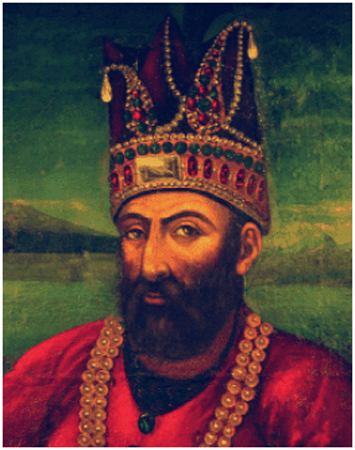 From nebulous beginning to ruthless intrigue, military success, and splendour; terror, frustration, ferociousness, zealousness and death. An obscure warlord, who liberated Persia from occupation by the Afghans, ejected the Ottoman, manoeuvred the Russians out of Persia, invaded ottoman territory, attacked the Afghans in their homelands and reconquered them, then invaded India, conquered Delhi, broke into Central Asia pacified the Uzbeks. The Army he created was the single most powerful military force in the world. But after Delhi he began to fall apart. He fell ill, lapsed into obsessive covetousness, rage, and cruelty, and in the end was murdered by his own officers. He was surprised in his sleep by around fifteen conspirators, and stabbed to death. Nader Shah was able to kill two of the assassins before he died.
Nader Shah was brought up as a Shi’a but later espoused the Sunni faith as he gained power and began to push into the Ottoman Empire. The Safavids had introduced Shi’a Islam as the state religion of Persia .He believed that Safavid Shiaism had intensified the conflict with the Sunni Ottoman Empire. His army was a mix of Shi’a and Sunni. He wanted Iran to adopt a form of religion that would be more acceptable to Sunnis and suggested that Iran adopt a form of Shiasm he called Jafri, in honour of the sixth Shi’a Imam Jafar al-Sadiq. The ninth Ottoman Sultan, Sultan Selim the Resolute regarded Shia Qizilbash as heretics. Nader Shah hoped that Jafarism would be accepted as a fifth school of Sunni Islam and that the Ottomans would allow its adherents to go on the hajj, or pilgrimage to Mecca, which was within their territory. In the subsequent peace negotiations, the Ottomans refused to acknowledge Jafaris as a fifth school of thought but they did allow Persian pilgrims to go on the hajj. Persians were not allowed to travel to Mecca under Ottomans. Nader Shah was interested in gaining rights for Persians to go on the hajj in part because of revenues from the pilgrimage trade. Nader’s other primary aim in his religious reforms was to weaken the Safavids further since Shia Islam had always been a major element in support for the dynasty. He had the chief mullah of Iran strangled after he was heard expressing support for the Safavids. Among his reforms was the introduction of what came to be known as the KOLAH-e NADERI. This was a hat with four peaks which symbolised the first four Rashidun caliphs.
Nadir Shah’s shift towards Sunnism was purely political. Beyond Persia, his conversion signified a bid for hegemony within Islam as a whole; an assertion of his wider political position that would have been impossible had he and his regime remained Shia. There was no religious drive, rather an urge to dominate the world he knew.
Nader Shah once had a conversation with a holy man about paradise. After what that man described miracles and pleasures of the heaven, the Shah asked: Are there such things as war and victory over the enemy in paradise? When the man answered negatively, Nader replied: How can there be any pleasure then?
Nader Shah’s French physician wrote that Nader believed himself to be as great as Prophet Mohammad or Ali Ibn e Abi Talib because they were great only through having been great warriors, and he had achieved as great a degree of military glory as they. He also added that it was difficult to know what religion he followed, many who knew him best said he had none.
One story says that an arrow was once shot into his tent with a note attached, accusing him of tyranny and irreligion, demanding of him whether he was a devil or a god, a tyrant, or prophet. Nader Shah replied, I am neither a god, nor devil; but I am sent from God, to punish an iniquitous generation of men.
Nader Shah’s choice of red for his clothing, the traditional colour of Royal punishment, only worn by the Safavid Shahs when passing death sentences on wrongdoers.
If Nader Shah had passed on a strong state to his sons, and Ottomans would’ve accepted his proposal to accept Jafarism as the fifth school of Islam, his vigorous dynasty might have preserved Persia’s territorial integrity. It is quite conceivable that a dynamic Persia expanding into the vacuum left by Mughal and Ottoman powers, under a dynasty that sought to overcome the schism between Shia and Sunni Islam could have averted the relative decline of the Islamic world.
The writer is a traveller and freelance writer based in UK