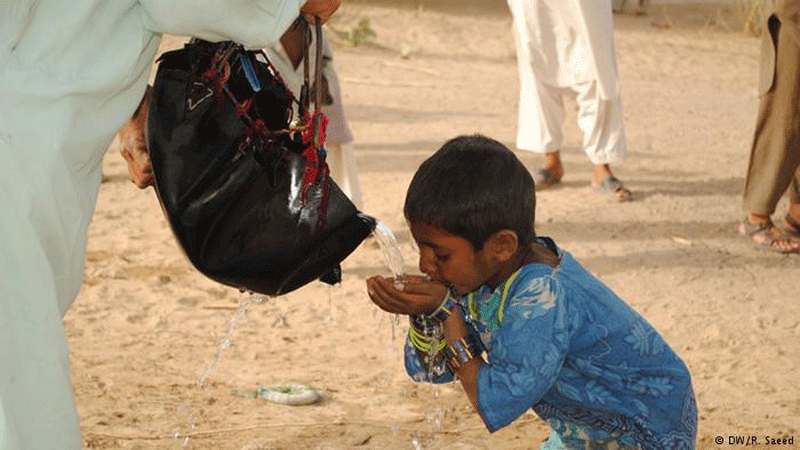
Pakistan is a water stressed country and recent reports have alerted that the country could reach absolute water scarcity by the year 2025.
Reports have also stressed upon the need for a groundwater regulatory framework in the country that will guarantee a sustainable and equitable use of groundwater resource. According to Pakistan Council of Research in Water Resources (PCRWR), over 60 percent of Pakistan’s irrigation water requirements are met from groundwater sources which also provide over 90 percent of the country’s potable water. In addition to this, almost all of the country’s industrial water in acquired from groundwater sources.
Despite this, Pakistan has no comprehensive water laws defining rights to groundwater resources and there is no legal or policy framework to deal with the issue of groundwater usage on intra and interstate levels. Consequently, the country has failed to control overexploitation of groundwater resources.
According to Dr Pervaiz Amir, who is an expert on water, there is a dire need to rationalise the rates of groundwater. “There is no regulatory framework governing this domain,” he said. Stressing on the importance of legislation, Dr Amir remarked, “legislation is vital since some commercial companies and individuals are involved in extreme extraction of groundwater.”
“Beverage companies are earning Rs. 50 per liter and in return paying government only 20 paisa per liter,” said Dr Amir. “Also, some growers, especially sugarcane growers are actively involved in extracting large quantities of water,” he said, adding “solar tube wells are provided free electricity so that also encourages the excavation of groundwater.”
“If a regulatory framework is not devised soon, salinity would increase and we will be robbed of our groundwater sources,” he warned. “In Pakistan’s first-ever National Water Policy (NWP), there is a major element mentioned to specify the regulatory framework of groundwater. It is hoped that within next year or so, we may see some progress in this regard,” he said.
Sindh is also adversely affected in this scenario where 70 percent of the ground water is saline. Pakistan has around 55 million acre feet (MAF) of groundwater, out of which Punjab has 35 MAF whereas Sindh has the remaining 20 MAF. In most areas of Sindh, groundwater needs to be mixed with canal water before it can be effectively utilised for agricultural purposes.
The fact that Sindh received 40 percent less monsoon this year compared to last year only aggravates the situation since now every cultivator will attempt to excavate maximum groundwater in order to save his crop.
A PCRWR report on “Groundwater Investigations and Mapping in the Upper Indus Plain” mentions that sufficient groundwater is available in the Upper Indus Plain, however, indiscriminate installation of tube wells and pumping are threatening the aquifer in many parts of the province. “For instance, in 1960, the number of tube wells in Pakistan was about 20,000 which have now increased to over one million,” reads the report. “This drastic and indiscriminate installation of tube wells has changed the hydro-salinity behavior of the Indus basin and groundwater is depleting in many canal commands and almost in all urban settlements,” says the report.
Another problem linked with the depletion of groundwater resources is climate change. According to the PCRWR report, climate change is compounding depletion of groundwater resources by disrupting the natural hydrological process of groundwater recharge. According to the report, increasing variability of monsoon rains, rapid melting of glaciers and prolonged droughts are threatening the natural recharge of the Indus aquifer through surface water.
While flooding of the basin from rapid melting of glaciers is beneficial for groundwater recharge, the melting of the glaciers is projected to lead to prolonged droughts. This would consequently compel farmers and residents to increase groundwater extraction.
In March this year, National Assembly Standing Committee on Climate Change was informed that the groundwater table in every city of Pakistan was falling by one meter every year. “Groundwater is also becoming contaminated throughout the country faster than ever. Uncertain rain patterns are not recharging the aquifer, a consequence of climate change,” the committee was told. The committee was also requested to charge citizens for pumping water from the aquifer to make them realize that it is the most precious commodity and should not be wasted.
According to PCRWR, Pakistan’s reliance on groundwater is threatening sustainability of this sensitive freshwater resource. The amount of water abstracted from aquifers of the Indus River basin reservoir is not adequately recharged through natural or artificial means, resulting in water depletion.
The social and economic effects of declining water tables vary. The upper riparian of the Indus River basin – farmers in northern Punjab, who have access to canal heads and the river – are relatively water secure since the water table in these areas is high as water is sufficiently recharged through seepage from canals and rivers. However, downstream farmers face inequity and receive less river and canal water. This, in turn, affects the recharge of groundwater in downstream areas. “Consequently, the cost of irrigation is 2.19 times higher at the tail end of the Indus River basin, compared to the northern Indus River basin,” PCRWR report states.
Depleting water table in the coastal areas results in sea intrusion thus rendering the land unsuitable for agriculture or drinking. Pakistan is one of the top 10 countries with the lowest access to clean drinking water. According to a study by WaterAid, Pakistan ranks number 9 in the list of top 10 countries with lowest access to clean water and 21 million (m) people out of 207 m citizens of Pakistan, do not have access to clean drinking water. “Only seven percent of total industrial, municipal water is treated in Pakistan and the remaining 93 percent of it is dumped directly in water bodies. This polluted water then seeps into the ground and mixes with groundwater” says the study.
According to Nadeem Ahmad, a representative of WaterAid in Pakistan, inavailability of drinking water is a pressing issue. “If we want to solve drinking water problem at once, it can be solved through proper groundwater management and that can be done by improving ground water quality,” he said.
“There are two major issues in terms of ground water: quality and irresponsible extraction. The extraction is being done for industrial, agriculture and domestic purposes. In order to improve groundwater, discharge of sanitation into groundwater should be controlled because it is the main polluter,” said Nadeem Ahmed.
Recently, Advisor to Sindh Chief Minister (CM) on Information Barrister Murtaza Wahab stated that 60 small dams, bunds and weirs had been completed in Sindh whereas the construction of 21 dams of similar size and nature was underway.
However, experts like Sono Khangharani have questions about the policies pertaining to the consumption and usage of water. “In two third of Sindh there is no groundwater. Even when groundwater is available, it is saline and cannot be used for any purpose. There is potential in catchment area of Indus River or canal system so it is crucial for Sindh to form a policy regarding groundwater,” said Khangharani.
According to Sono Khangharani, a rural development expert based in Sindh, in the absence of a comprehensive groundwater policy, mining companies would continue depleting the groundwater sources, especially in Thar Desert where several coal projects are underway. “The level at which mining is carried out, one day the groundwater which is the only source of drinking water in Thar, will be completely exhausted and the locals would be deprived of potable water altogether, “he explained.
Published in Daily Times, September 17th 2018.