The Group of Seven (G7) summit this week in Charlevoix, Canada, reiterated their commitment to “shared values of freedom, democracy, the rule of law and respect for human rights and our commitment to promote a rules-based international order” but was silent about subjugated Kashmir. The G7 deplored nuclear and missile proliferation but was silent about the weapons of proliferation in South Asia fuelled by Kashmir.
Leaders of the key industrial nations identified global terrorism as the pre-eminent threat to international peace and security, but were silent about the terrorism flowing from wholesale denial of political freedoms in Kashmir. These three neglects of the G7 summit must be addressed to escape international peril.
The G7 very rightly ‘call(ed) upon the international community to take strong action against these abuses (human rights etc) all over the world’. That recognition applies equally to Kashmir, an erstwhile princely state denied self-determination and political dissent since its occupation by India 70 years ago. As the New York Times stated on May 18, 2018, “the struggle over Kashmir is one of those territorial disputes that seem only to deepen and to assume greater symbolic importance as decades go by and the atrocities and resentments on both sides pile up.”
The United Nations Security Council has passed resolutions stipulating a free and fair self-determination plebiscite “under the auspices of the United Nations”. The stipulations echoed icons of India’s politics. Mahatma Gandhi amplified on October 30, 1947 that “(Kashmir’s) accession [to India] was provisional upon an impartial plebiscite being taken by Kashmiris.” Pandit Jawaharlal Nehru, India’s celebrated first Prime Minister declared on January 2, 1952, “We have taken the issue to the United Nations and given our word of honour. We have left the question of final solution to the people of Kashmir.”
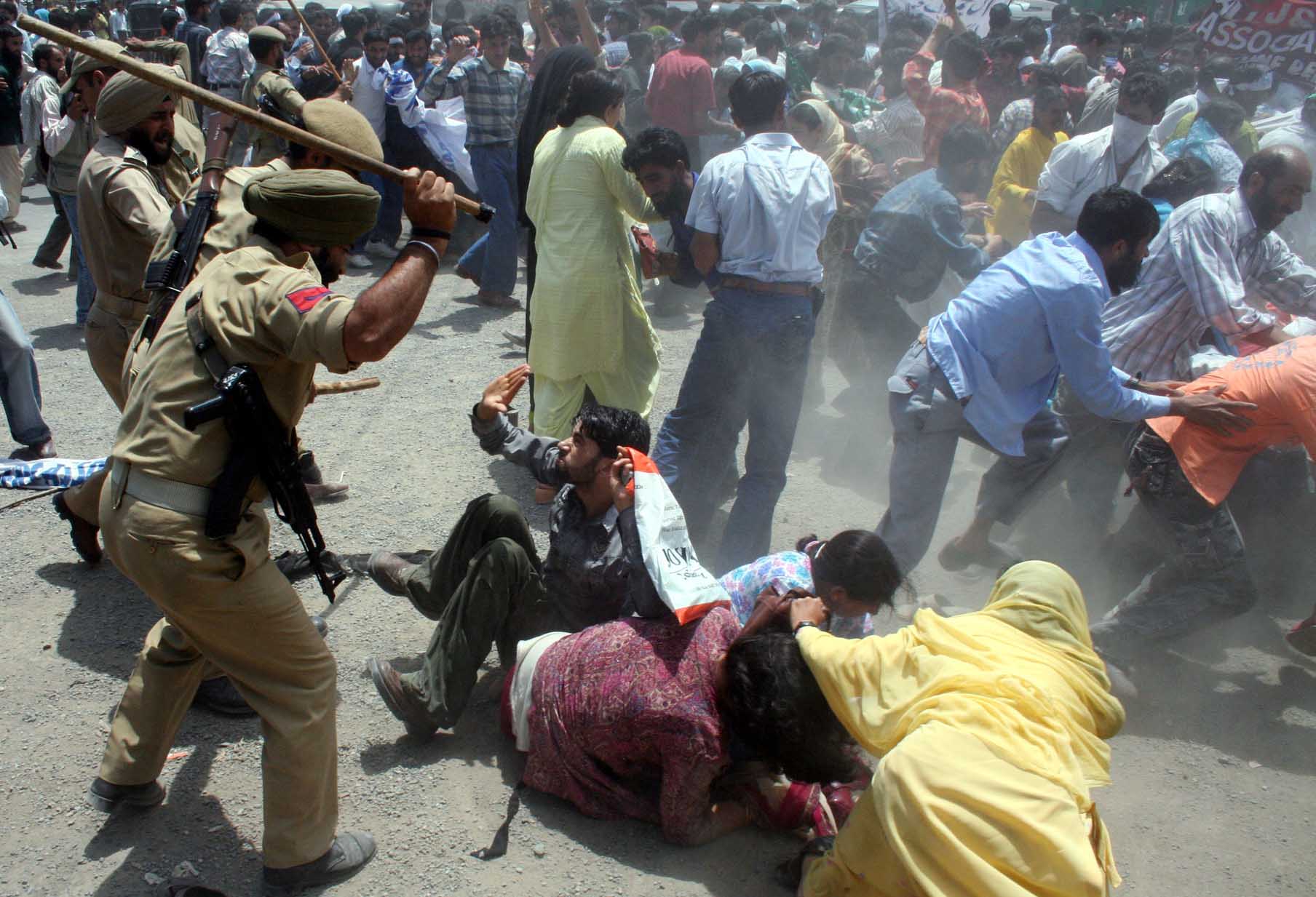
India, however, reneged on its international law obligation, and imposed puppet governments in Kashmir for contrived reasons of national security and secularism. The fundamental right to speak and to demonstrate in favour of self-determination was and is being ruthlessly suppressed. The consequences have been harrowing.
Kashmir is the most densely soldiered territory in the world, hosting more than 700,000 Indian military and paramilitary personnel. Since the 1989 Kashmiri uprising against alien illegal occupation, more than 100,000 Kashmiris have been killed or more than all US military fatalities during the Vietnam War.
Neither country is a signatory to the Treaty on the Non-Proliferation of Nuclear Weapons. Expert consensus has Kashmir, not Iran, as the most dangerous nuclear hot spot on the planet.
Furthermore, thousands of Kashmiris have disappeared in custody; torture has paralysed additional thousands; women of all ages have been routinely raped; property worth billions of dollars have been destroyed; and, arbitrary detentions have become as regular as the rising of the Sun in the east and its setting in the west.
The denial of democracy and human rights in Kashmir, especially self-determination, has spawned nuclear and missile proliferation. It is the only region in the world which shares its borders with three nuclear powers – India, Pakistan & China. Kashmir has been an open wound in India-Pakistan relations for more than 70 years.
The rivals have fought two wars over the territory and have fortified their positions by testing nuclear weapons and developing intermediate range missiles. Neither country is a signatory to the Treaty on the Non-Proliferation of Nuclear Weapons. Expert consensus has Kashmir, not Iran, as the most dangerous nuclear hot spot on the planet.
The hallmark of Kashmir has been its long tradition of nonviolence, tolerance, and friendship across religious and cultural boundaries: Muslims, Pandits, Buddhists, Sikhs and Christians. But the closing of peaceful political avenues in support of self-determination and human rights has boosted the attraction of violence and killings in this unfortunate land. Resolving Kashmir in accord with the wishes of its 22 million people would mark a major defeat for international terrorists. The New York Times, May 18, 2018 is right on the mark when it suggested, “A solution to a conflict that touches on so many religious and nationalist nerves must ultimately come from within, through talks among India, Pakistan and the people of Kashmir.”
In 1938, British Prime Minister Neville Chamberlain scoffed at the Nazi menace to Czechoslovakia as a dispute over a faraway country about which little was known. His irresponsible neglect precipitated World War II. The G7 should learn from that, and end its neglect of Kashmir to avoid a corresponding calamity.