
Churchill had used the expression ‘shameful flight’ to describe the hurried British exit from India. UCLA’s Stanley Wolpert, the biographer of Jinnah, Nehru and Gandhi, made that phrase the title of his book about Partition.
In a BBC interview given shortly after the Indo-Pakistani war of 1965, Mountbatten resorted to vulgar language to confess that he had messed up. In his book, Wolpert narrates the events leading to the transfer of power in India, some well-known and some not so well-known. In doing so, he also puts some myths to rest.
First, the Partition was inevitable in August 1947. “I believe the tragedy of Partition and its more than half century of a legacy of hatred, fear, and conflict — capped by the potential of nuclear war over South Asia — might have been avoided, or at least mitigated, but for the arrogance and ignorance of a handful of British and Indian leaders.”
Wolpert opines that additional talks between the British and Indian leaders ‘might have helped all parties to agree that cooperation was much wiser than conflict, dialogue more sensible than division, words easier to cope with and pay for than perpetual warfare.’
Second, the Muslim League was a democratic party. It was founded by ‘feudal princess and landlords.’ Only many years later did Jinnah join the party and give it national stature.
Third, the British opposed the creation of Pakistan. Prime Ministers Stanley Baldwin and Winston Churchill, along with Tory party leaders Lord Birkenhead and Sir John Simon, encouraged and supported the Muslim League because it provided a ‘useful imperial counter’ to the Congress.
Churchill strongly ‘favoured Jinnah over Gandhi’ and ‘the idea of Pakistan.’ Jinnah wrote to Prime Minister Attlee, calling the proposals put forward by the Cabinet mission as a betrayal of the Muslim League and a concession to the Congress’s vision of a Hindu Raj, and he also sent a copy of the letter to Churchill.
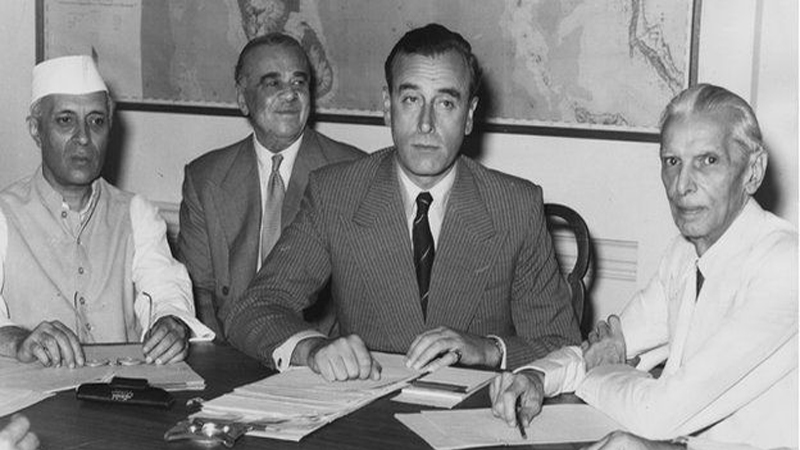
Wolpert says that “Jinnah was wise enough to take full advantage of official British favouritism” toward the Muslims. Five months after the Second World War begun, Jinnah spoke at the League’s ‘largest and most important meeting in Lahore,’ and announced unequivocally his intention to create ‘an independent nation-state of Pakistan.’ Jinnah demanded the creation of Pakistan as ‘Muslim India’s post-war reward for the service of its loyal troops and for the support Muslims leaders provided to the viceroy and his governors.’
Fourth, Pakistan did not have religion in its DNA. Mountbatten says Jinnah cited the fundamental religious differences between Hindus and Muslims to Cripps: “Muslims have a different conception of life from the Hindus…. How are you to put 100 millions of Muslims together with 250 million whose way of life is so different?”
Additional talks between the British and Indian leaders ‘might have helped all parties to agree that cooperation was much wiser than conflict’
Jinnah was clearly talking about differences in Muslim and Hindu identity arising out from religious differences rather than about their ethnic differences. He meant the differences in their way of life, stemming directly from the differences in their faiths. Jinnah cited how the killing of a cow was a cardinal offence for the Hindus but ‘meant nothing to Muslims.’
Fifth, the 1940 Pakistan Resolution approved in Lahore meant two independent states, one in the northwest and one in the northeast. While the wording of the resolution was ambiguous, Wolpert says “When Jinnah was questioned by journalists the next morning he insisted it meant one Pakistan. That remained his League’s single most important demand.”
In fact, that was the essence of the opt-out provision in Cripp’s proposal. Wolpert says that Jinnah was pleasantly surprised when he read the provision since it seemed to go significantly toward meeting ‘the Pakistan case.’ The only suggestion he made was to clarify the language about the possibility of creating a second dominion. In other words, he wanted a single homeland for the Muslims.
Wolpert points out that while Britain had been leaning toward Pakistan until Mountbatten’s arrival, the pendulum now swung the other way as the transfer of power approached. Mountbatten had bonded instantly with Nehru but not with Jinnah.
The situation worsened when Jinnah decided to become the Governor-General of Pakistan, despite Mountbatten’s desire to be the Governor-General of both dominions. Wolpert comments that “Jinnah’s refusal to accept Mountbatten’s repeated offer to serve as Pakistan’s governor-general… was … important in tilting what should have been Great Britain’s even-handed transfer of power balance in favour of India.”
Mountbatten wired Attlee in early July, telling him that he had argued with Jinnah for four hours about this issue, “trying to make him realise that that the advantages that Pakistan would gain from having the same Governor-General as India… until partition is complete. He is so adamant that he openly says that he would prefer to lose [tens of millions of rupees] worth of assets…then share a Governor-General.”
Mountbatten said he was so angered by Jinnah’s ‘stubborn refusal’ to do what he wanted that he finally ‘got up and left the room,’ after warning Jinnah “somewhat acidly ‘It may cost you the whole of your assets and the future of Pakistan.’” This ended up turning into a grim prophecy.
Jinnah did not want Pakistan to be a narrow-minded theocracy, a feudal tyranny, or a martial dictatorship. However, it became all three. He wanted Pakistan to be a democratic polity governed by law and equal opportunities for all. It never became one.
In his August 11th speech, Jinnah had envisioned a state where people of all faiths would live in complete harmony as ‘equal citizens of one State,’ free to worship as they pleased in their churches, mosques, and temples. But his Muslim followers found that liberal idea ‘impossible to comprehend.’
With his health failing fast, Jinnah ‘lacked the strength to help Pakistan create and securely establish the vital democratic institutions it so desperately needed.’ In his worst political decision, Jinnah imposed Urdu on the Bengalis of East Pakistan hoping to impose unity from above. This was to create an irreparable schism that would ultimately shatter his dreams of a single Muslim state.
Towards the end, ‘Jinnah knew his lungs were failing him, and he wanted to lead the nation he desired, if only for the briefest period of time vouchsafed to him.’ Of course, this was a closely guarded secret. When Jinnah passed away, the nation suffered a body blow.
It has been argued that Pakistan would have fared better if Jinnah had lived longer, becoming ‘one of the greatest Nations of the world’. Wolpert does not offer an opinion on the matter.
The writer is a defence analyst and economist. He has authored Rethinking the National Security of Pakistan (Ashgate Publishing, 2003)
Published in Daily Times, May 13th 2018.