 Our Washington Correspondent
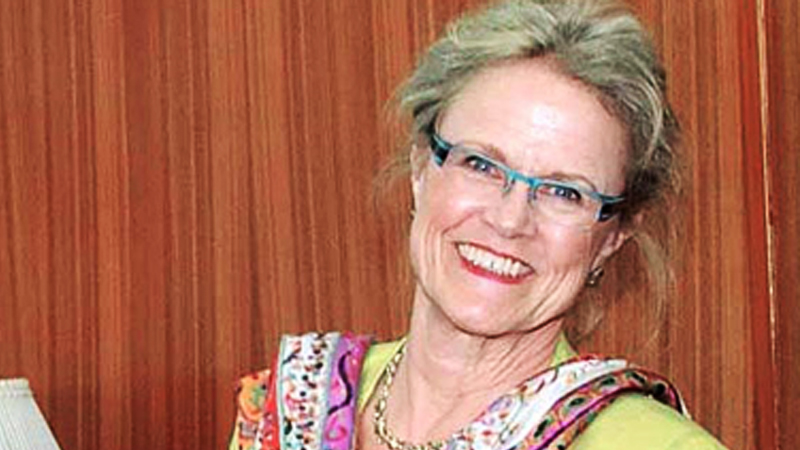
Robin L Raphel, is a retired ambassador who until recently was a senior adviser to the US Sate Department’s special representative on Afghanistan and Pakistan.
A former ambassador to Tunisia, Raphel had also served under former US president George W Bush as coordinator for reconstruction in Iraq.
Raphel has spent decades shaping American policy towards Pakistan. She has spent years helping to disburse billions of rupees in civilian aid to Pakistan and conducting tough diplomatic work to smooth the frequently fraught US-Pakistan relationship.
She made her first trip to the South Asia region in 1971 to work as a teacher in Iran.
Renowned for her enduring affection for Pakistan, she continues to challenge Washington policymakers and lawmakers who have become disenchanted with what they believe as Islamabad’s “duplicity in the war against terrorism”.
A seasoned diplomat Raphel understands in order for diplomacy to be effective it is imperative to understand the perspective of both entities.
American officials accuse Pakistan of maintaining influence and supporting the Taliban, including the group’s most ascendant faction, the Haqqani network, which is viewed as one of Afghanistan’s most experienced and sophisticated insurgent organisations.
The Trump Administration announced in January it was suspending military aid to Pakistan until the country took more action against terrorist organizations that have targeted Americans.
Raphel continued: “It is hard for the Pakistanis to deal with the Haqqani issue because they fear blowback and they have cultural ties. We want very specific action on the Haqqanis. The Americans are no longer interested in excuses or in complications. They just want it to be dealt with.”
Raphel noted the core interests of the US in working within Pakistan include “preventing the area from being a safe haven for terrorists, nuclear weapons containment, and regional stability”.
Pakistan, she explained, seeks a strong relationship with the US, recognition for its role in the war on terror, a balance in the U.S. South Asia policy and a guarantee they will remain in Afghanistan.
As first assistant secretary for South and Central Asian affairs, Raphel prioritised resolution of the Kashmir problem to reduce tensions between Pakistan and India as one the central policy positions during her tenure. Her characterisation of Kashmir as “disputed territory” was a first in the annals of US diplomacy. This made her popular in Pakistan but deeply unpopular within India.
Responding to a question as to whether the US administration is aware of Pakistan’s concern about India’s rising influence in the region, she said: “How could they not be. Pakistanis say it all the time. However, the Pakistanis should have been explicit earlier in their relationship with the US.”
She believes “Pakistan’s ambiguity reduced the productivity of the US-Pakistan relationship. “I think like everyone else, Pakistan exaggerates India’s role but then the US also down plays it.”
Raphel thinks Pakistan needs to help US policymakers to better understand its perspective. “Pakistanis think the Americans don’t know what they are doing in Pakistan and they don’t know what the end game is, and that too, to a certain extent is true.”
Speaking about those in Washington that believe Pakistan’s “subterfuge impedes the peace process in Afghanistan”, she explained: “Pakistan does not want the Taliban in charge in Kabul but they worry about the break up – they worry about India and Russian support for the alliance – they worry about that -as much as they deny it. But it’s not because they want something different to what the US wants. When people say the Pakistanis are trying to destabilise Afghanistan I disagree.”
She added, “I don’t know if the US will remain indefinitely. But there are several issues in play: given the growing concern of the global roles of Russia and China. “I think our military guys think why have we spent over $45 billion in Afghanistan?” She does not think the US will completely withdraw because “there is the same concern as to what are Iran, China, India and Russia up to”. She envisions the US to retain some bases in Afghanistan; is of the opinion this would not be an adverse move adding, “ironically the Pakistanis do not want us to leave.”
Recently, Raphel was an observer at a conference held by Pugwash, a Nobel Prize-winning science group dedicated to promoting peace. The meeting saw participation between representatives by the Taliban and Afghan government. A statement at the time from the Taliban called them a “research conference” while Afghan officials described them as “scientific discussions”.
However, Raphel emphasised, “They were not peace talks.” She described them as “an informal exchange between the two sides, a platform to speak, similar to a track two, a safe meeting ground.” In her view the communication between the parties “helped people better understand what the other person was thinking”. The meetings lasted over two days.
Speaking about prospects for a peace settlement in Afghanistan she said. “I think everyone is tired of the fighting and there is some space here for a way forward – and it will require a third party to help resolve – someone who will be dispassionate and it has to be someone with some stature – and not an American.”
Beyond security, she is certain the US will continue to remain engaged in Pakistan. “Whatever has happened with terror and security you still have Pakistan sitting there, a population of around 200 million -strategically located at a crossroads between Europe and Asia. It has enough enormous resources – agriculture – energy –economy – it is a democracy, however flawed – it has influence in the Islamic world – it has a youth bulge and that could be helpful.”
She dismissed the school of thought who believes the US will disengage from Pakistan once the war in Afghanistan is over. “If the US wants to be a global player – it is a country that we need to be engaged with in a sophisticated way.”
Referring to Pakistan’s concerns that the US continues to develop its relationship with India, she said taht the US had been trying to separate India and Pakistan for decades and needs to be engaged with both. “India is a bigger country with an even bigger democracy, nuclear arsenal, resources and huge investment opportunities that makes it a fruitful relationship for the US. Both countries are significant to the US,” she said. Although she added, “India is in many ways more difficult for the US to deal with than Pakistan. They (India) don’t want to be our tool with China at all. So in many ways Pakistan is more potentially accommodating than the Indian’s.”
Though the relationship is fraught Raphel believes the overall prognosis for US-Pakistan relationship is “promising and shall continue”. “It is too important for us to ignore or abandon Pakistan,” she said.
Published in Daily Times, May 4th 2018.