
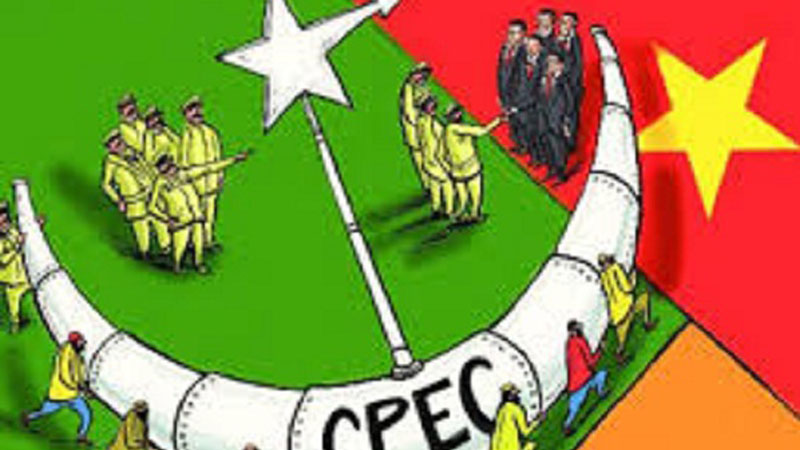
The bliss of CPEC has enveloped the whole town without any doubt. Folks no more ask questions on reliability, feasibility, and viability of the projects it encompasses but rely only on the prescribed mantra of ‘game changer’ for the region in the globalised world.
This one may not be a wrong approach when their space to be critical is narrow and the available information is incomplete or ambivalent. No one is fearful of living in Sri Lanka 2.0, certainly.
But there is every reason to be fearful and critical, for it ensures care, vigilance, transparency, and long-term interests of both sides involved.
China, as a matter of fact, is probably the largest investor in pariah, conflict-ridden, and politically unstable countries in Asia, Africa, and Americas. From Peru to Zambia to Iraq, the decision-makers find themselves comfortable whilst working with the Chinese investors and using Chinese money with no political strings attached. What can be more comfortable but no heed to good governance from the investor? Despots and opportunists, in this way, take credit of bringing investments and forging friendships. In return, signing a deal without required scrutiny and implementing no strong regulatory regimes are therefore no big deals for them.
In recent times, Robert Mugabe of Zimbabwe, Omar al-Bashir of Sudan, military Junta of Myanmar, Kims of North Korea, and their cousins by practice had rarely anyone to look toward for help and investment but China. The latter’s practices embedded in “business is business” paradigm. Diplomacy also backed up trade and provided opportunities to state-owned enterprises and private businesses to expand their reach far from the homeland. With competition virtually absent in the above places, there was nothing that could stop the enterprises from ignoring local laws, exploiting labour, showing disdain for the environment, and promoting corruption.
In a state like Pakistan where foreign investment remains low, with investors unwilling to take a risk, China is probably the only country willing to lend money
The enterprises also ignored Chinese laws. And they missed no opportunity of maximising profits even when their practice brought a bad name to China or turned the locals’ sentiments against the Chinese. There are dozens of anecdotes. For instance, the Chinese (mining SOE Chalco) had to face a hard time in Mongolia where local workers opposed the growing numbers of the Chinese laborers. The Chinese investors, on the other hand, called the locals lazy and alcoholic. At Peru’s Marcona mine, unsafe working conditions, poor residence, low wages, and the difference between the wages of Chinese and non-Chinese workers led to protests and strikes against Shougang group.
Peru might be famous for union strikes, but the strikes at Marcona in 2010, 2011, and 2012 exceeded the national average. In another instance, in Papua New Guinea, China Metallurgical Group Corporation’s decision to dump 100 million tons of heavy metal and toxic mine waste into Basamuk Bay over a twenty-year period resulted in significant opposition from the activists and locals who based their arguments on both technical and moral basis. The subsequent stalemate involved court that found itself stuck between saving the environment and attracting foreign investment. Both considerations had long-term effects after all.
Not far away from here, in Afghanistan, corruption outweighed the security concerns. Aynak copper mine project reportedly involved graft of $30 million to the minister of mines and industry. None in the ministry had had any experience of finalizing a deal of this magnitude and taking an unambiguous position on technical aspects. Or Argentina’s Rio Negro province, where a land-acquisition deal (320,000 hectors for two decades) for agricultural purposes involving Beidahuang group (from Heilongjiang province) went bad. Then in Ghana, the Chinese (private) unregulated miners swarmed in with virtually no respect for local laws. Ghanaian ministers could not do anything but warnings about the negative impact of events on China-Ghana friendship. Any crackdown might have led to repercussions for the government or invited undesired Chinese wrath.
Stopping the unwanted activities of Chinese companies in Ghana was only possible when the Chinese state itself pushed the host government to take an action and deport approximately forty-five hundred Chinese citizens. In some of the cases, in fact, the government took the lead to streamline practices of Chinese companies by passing certain laws and introducing regulations to comply with. Export-Import Bank and China Development Bank necessitated the companies with projects overseas to stand high in environmental impact assessments. Failing in EIA means, reapplying for a loan to EXIM which is the largest source of loan for overseas investment.
But how would this all be possible in the case of Pakistan? Who would oversee and ensure transparency and effective investment even if corruption and environmental degradation are sure to occur? In a state like Pakistan where foreign investment remains low with investors unwilling to take a risk, China is probably the only country willing to lend money. It would therefore be unwise to create complexities. Yet it is equally important to create strong regulatory regimes, expose the bidding process, finalize the labour split, simplify the nature of agreements, and clarify the objectives of the CPEC. After all, ‘game changer’ is not an objective Pakistanis are vying for.
Similarly, it is important to make clear the nature of Chinese investment. The exact amount — ranging from $46 to $56 billion according to different reports — CPEC offers is a grant, interest-free loan, concessional loan, market-rate loan or whatever, the people have a right to know even if it demands contrary to the populist agendas of political parties and security narrative of non-political forces. Poor governance, instability, insecurity further make it necessary since, in recent times, the country has endured the waste of billions of PKR in absurd projects. But CPEC is no ordinary deal, for sure. Pakistan should be careful and effective regarding the project, for it impacts the lives of not only this generation but also those of the next.
The writer is PhD candidate at Area Study Centre, Quaid-i-Azam University. He’s previously a visiting fellow at Fletcher School of Law and Diplomacy. He can be reached at [email protected]
Published in Daily Times, March 25th 2018.