
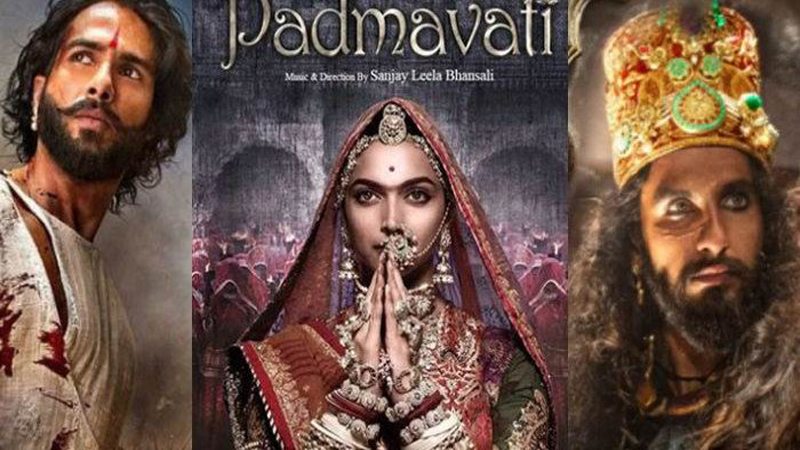
The movie broke box office records in New Zealand. It was banned in Malaysia, reviewed in England and panned in the New York Times.
Some Pakistanis gave it a failing grade, since it portrays a Muslim king as a brutal and despicable tyrant. It evoked violent protests in India, since it seemed to glorify the practice of sati. Leading actress received death threats. The director was threatened on stage. Rarely has a movie stirred such human emotions.
The opening sequences of the film are set in Afghanistan where, oddly enough, men are shown dancing to Arab and not to Afghan music.
Then the action switches to a dream-like forest setting across the seas in Sri Lanka where a young woman, perhaps a princess, is hunting speckled deer with a bow and arrow. She is shown jumping over obstacles as if she is in flight, evoking the special effects seen in high-techmovies such as Avatar and Crouching Tiger, Hidden dragon.
And then comes a moment of high drama. Instead of shooting a deer, she shoots a young man who turns out to be a prince who is visiting her family from the Kingdom of Mewar. He had come looking for pearls. And he found her or she found him – depending on your interpretation.
This is the classic encounter which has laid the foundation of many a romantic yarn. Surprisingly, the scenes that follow immediately after that encounter are poorly staged. They are marred by overacting and a childish dialogue.
But the costumes and the architectural settings are elaborately and elegantly done. They acquire amazing depth in 3D. The film is sound technically.
The film captures all the butchery and savagery that men inflict on each other. But similar scenes in the Games of Thrones TV series have not evoked any protests
It turns out that the movie is based on an epic poem, Padmavat, written by Malik Muhammad Jayasi, a Sufi writer, in 1540. He wrote it in the language of Awadh in the Persian naqshbandi script. It describes events that took place in 1303 involving the Sultan of Delhi, Alauddin Khilji. Interestingly, when the poem was written, it did not ignite a firestorm of protests.
The action sequences that follow are well staged but often predictable. The dialogue is crisp and dramatic. Battles are fought in the desert around a fort perched high on a hill with steep ramparts.
It is the Chittor fort in Rajasthan, one of the largest in India, and the place where from where the legend of Rani Padmini originated. She was a woman of uncommon beauty, perhaps on par with Helen of Troy and Cleopatra of Egypt.
In the battle sequences, the film captures all the butchery and savagery that men inflict on each other in combat, armed with swords and shields, bows and arrows, and horses and elephants. But similar scenes can be found in the Games of Thrones TV series and they have not evoked any protests.
There is a climatic, one-on-one fight, between the Muslim and Hindu kings two-thirds of the way into the movie. It evokes the apocalyptic fight between Hector and Achilles in the movie, Troy, which starred Brad Pitt.
There are a couple of strategically bizarre episodes that occur in the plot of the film. After months of siege, the Muslim king, who is possessed by a desire to seize the Hindu queen, proposes a truce to the Hindu king and seeks a dinner invitation.
That is accepted. He shows up unarmed and unescorted, as requested by the Hindu king, with whom he plays a chess match and then the two dine together. The Muslim king gets to see a glimpse of the queen whom he covets. Then he is allowed to leave the fort unharmed, despite his long-term hostility.
The bizarreness continues. The Hindu king shows up unarmed at the Muslim king’s tent, on the latter’s reciprocal invitation. But after a brief argument, he is taken hostage. His kindness is repaid with vengeance. He will only be released if he turns over his queen to the Muslim king. What follows is very dramatic, suspenseful and nicely choreographed.
So why are the Hindus upset with the film even though it shows the Rajputs in a very positive light? Probably because there is a scene at the end in which the Rajput widows are shown walking slowly and steadily in their bridal dresses toward an inferno, characterised as a ‘heavenly fire’, whose flames will transport them to an immortal world and preserve their earthly honor.
In other words, the movie is being criticised for accurately depicting this act of self-immolation (or jauhar) even though it was commonly practiced in those days. People are upset at their own past.
And why are the Muslims so upset? The villain is a Muslim king who is a most despicable man, a veritable savage who does not hesitate to murder his uncle, the king, to seize the throne of Delhi. He eats like a glutton, sleeps with multiple women, and on the advice of a Brahman, who has been sent into exile by the Rajput king, wants to marry the queen of the Hindu Rajput king.
It is entirely possible that if the villain had been a Hindu and the hero a Muslim, Muslims would probably have been raving about the movie. It is time to take a deep breath and let the mind drift back to the Middle Ages.
In those days, blood lust was common in imperial families across the globe, as was drunkenness, gorging on food, and chasing other women. The Muslim rulers were no paragons of virtue.
Many Muslim kings in history have behaved just like the Muslim king in the movie. There is no shortage of evidence from the Ottoman and Mughal eras that highlights the cruelty of Muslim royal to Muslim royal, son imprisoning his father, and brother killing brother.
Films based on epic poems have been made about the ancient Greeks and Romans but they have not led to any protests, let alone riots and death threats. Movies that come to mind where one party is shown as the personification of evil include Troy, Julius Caesar, Ben Hur and Godfather.
Not much happened in England when brave-heart or patriot, both starring Mel Gibson, were shown. Shakespearean plays are staged on a regular basis, showing romances set against a background of wars, rape, pillage, torture, beheadings and the burnings of people charged as being witches.
In the US, there is no shortage of anti-Vietnam War films, with ‘The Post’ being the most recent one. No protests have occurred.
All-in-all, Padmavat should be viewed as a movie based on an epic poem, part history and part fiction. It is designed to entertain and it does entertain. Several of the scenes are full of suspense, intrigue, witty dialogue, and are a delight to watch.
It is true that some of the scenes suffer from overacting and some of the other scenes belong in a cartoon cut-up book. The movie does drag at times and could have been shortened by 40 minutes. But then that is the fate of most epics. It is worth watching.
The writer is an avid filmgoer, especially of historical films. He can be reached at [email protected]
Published in Daily Times, February 9th 2018.