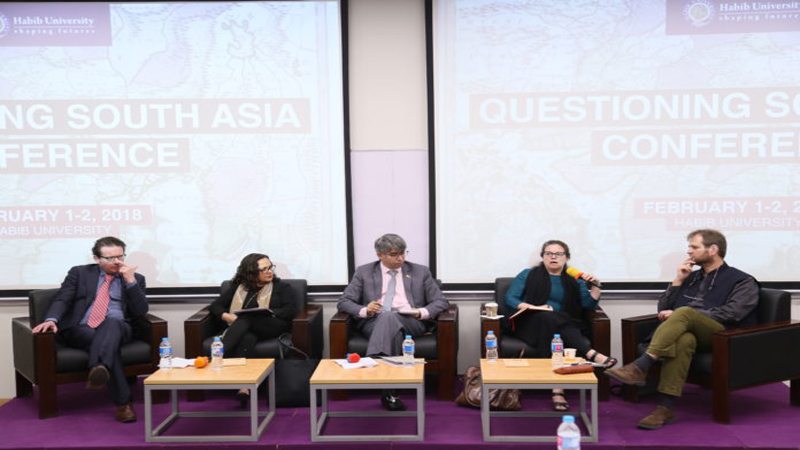
KARACHI: ‘Questioning South Asia’ – a two-day international conference – concluded at Habib University on Friday.
The conference featured academics from various disciplines in social sciences and humanities whose work on South Asia shared a research framework that went beyond the construct of the region as a territorially bound space with discrete nations.
Among the speakers was eminent scholar Dr. Markus Daechsel from Royal Holloway, University of London. Hi0s keynote speech was on the nature and value of history in South Asia.
Dr. Daechsel observed, “instead of arguing with and about history, South Asian politics has increasingly been guided by a desire to by-pass or even undo history.”
“The evidence of such a neglect of history is visible in the field of heritage destruction and architecture, but can also be observed elsewhere, in debates about school curricula or simply in the relatively low prestige enjoyed by history as compared to the social or natural sciences,” he said. The keynote address offered reflections on a number of themes related to the larger question: what does the new status and politics of history mean for our ability to write a decolonised history South Asia?
Dr. Daechsel concluded his address by suggesting that ‘such explorations have barely begun, but will acquire increasing importance when many of the old certainties of the 19th and 20th century modernity will be superseded’.
The two-day conference was organised around five panels. The first panel, ‘Revisiting Urdu Literary Traditions in South Asia’, offered insights into the diverse genre and forms of cultural representation of the region. Sarah Abdullah and Amina Wasif of Lahore College for Women University (LCWU) presented thought-provoking papers on the way the traditions of storytelling or dastangoi produced unique fictional characters, especially in Tilism-e-Hoshruba, the subcontinent’s first wholly indigenous Indo-Islamic fantasy epic.
The second panel, ‘The Politics of Othering in South Asia: Secularisation, Identity and Environment’, highlighted pressing contemporary challenges affecting the world. Dr. Nauman Naqvi of Habib University presented an apocalyptic assessment of geological changes occurring from the disastrous effects of ‘Anthropocene – a term used in academia to refer to the current geological age in which human activity is the most dominant force on climate.
Dr. Naqvi said, “this generation is what is called the generation of the great acceleration […] as we are living in an era of massive catastrophe and there are massive holes in our ecology.”
In her presentation, Saba Pirzadeh of LUMS highlighted that contemporary South Asian literature was a viable discourse for exploring the repercussions of war, especially as enacted on bodies and their urban movements. She said, “literature, if encouraged as a dialogue process, can be used for political potential […] One should not disassociate, as that is where the problem starts.”
The third panel, ‘Performance, Language, and Politics’, highlighted the cultural logic of South Asian societies.
Dr. Sean Pue of Michigan State University asked, “how literary studies of poetic performance can extend beyond single literary and language communities in order to break away from a monolingual cultural milieu?” Dr. Shirin Zubair of Kinnaird College discussed images and representations of women in South Asian popular culture. She argued, “in the wake of post-feminism, globalisation, and international development discussions, the imagery and representation of women in South Asian popular culture has raised significant issues regarding women’s changing social roles and identities.”
The fourth panel, ‘Retheorising South Asia’, brought together two well-known academics, Dr. Edward Simpson of SOAS, University of London, and Dr. Aasim Sajjad Akhtar of Quaid-e-Azam University. Both speakers reflected upon the changing contours of the region due to a vision for socio-economic development that prioritised mega-infrastructure projects.
Dr. Simpson asked, “How is infrastructural politics changing the shape of the region in terms of political and economic subjectivity of the people and how they think of boundaries.
Dr. Sajjad argued that recent investments in border regions had given rise to a new imperialism that was still purely triggered by strategic reasons.
The fifth panel, ‘Religious Movements, State and National Identity’, offered an insightful commentary on the confluence of religion and politics. Dr. Karen Ruffle of University of Toronto presented a paper that called into question hegemonic historical narratives of Shi?i origins in the Deccan. Shedding light on the ‘central place that material objects had in the formation of Shi?ism in Hyderabad, India’, she suggested a more complicated history of the Qutb Shahi dynasty and its relationship to Safavid Iran. Dr. Amina Jamal of Ryerson University, Canada, presented a paper on feminist subjectivity that was shaped by distinct experiences of gender, nation, secularism, and Islam all of which were unaccounted for in the framework of modern secularising states versus moral communities that upheld postcolonial critiques of secular feminism. Dr. Jamal argued for a more nuanced understanding of what was at stake when secularism was supported or denounced.
The conference also featured a roundtable discussion titled Future of South Asian Studies and Research. The discussion was guided by the following questions: what is ‘South Asian Studies’ and what role it plays in shaping the intellectual discourse and the allocation of resources to the various inquiries taking place under its rubric? How can productive and equal collaborations take place between emerging institutions in the postcolonial world and their counterparts in the West?
The conference ended with a commitment to raising awareness on global issues from the Habib University’s platform and to opening up spaces for critical discourses. Sessions on both days were attended by a large number of people including academics, students, and civil society representatives.
Published in Daily Times, February 3rd 2018.