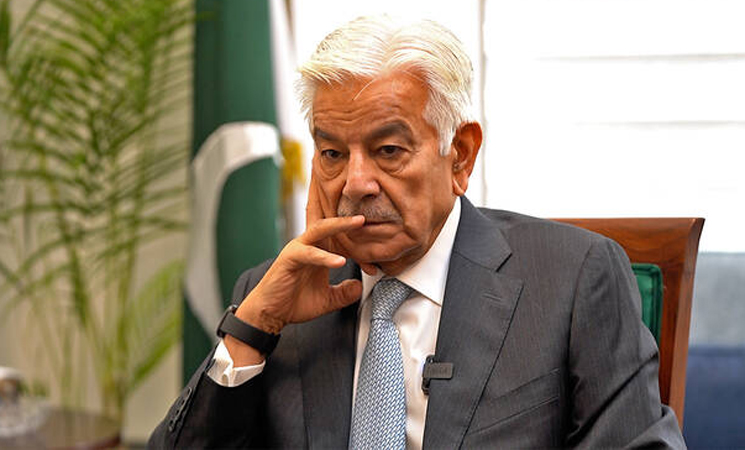
 Defence Minister Khawaja Asif said on Tuesday that Pakistan’s economy had left the “intensive care unit”.
He made the remarks while speaking in the National Assembly, during which he also talked about insecurity in Balochistan and Pakistan’s role in brokering the agreement with the United States and Iran.
“When we [presented] the first budget, we were insolvent. There was always the danger that we would default today or tomorrow. The International Monetary Fund (IMF) bailed us out with strict conditions, which we are now bearing but we have become solvent. Our economy is breathing; it has left the ICU,” he said. “I will not say that we are reaching the stars but our trajectory bears witness that in one or two years … we will reach a place where Pakistan achieves a growth rate of 6-7 per cent,” he said.
He said that there were multiple “inbuilt taxes” in the country, adding that “we have to get rid of all these things to become solvent”. He said that the tax rate should be brought to a level where the entire country was ready to pay it instead of becoming prohibitive.
“Why should we force people to search for ways to evade taxes? We should bring taxes to a level where a conducive environment is created, where people pay taxes and do so with pride,” he said. In his remarks, the defence minister also addressed the issue of terrorism in Balochistan, saying the situation had not been created “yesterday or the day before” but that many people had contributed to it.
“This problem is not of any one party or any one province,” Asif stated. “If there are problems in Balochistan … then I think the responsibility is our collective responsibility, and its solution should be such a solution that it is acceptable to Balochistan’s public, whether they are Baloch or Pashtun.” On Afghanistan, Asif noted that people had complained that Pakistan should negotiate with the Afghans and that the leadership’s approach was “impersonal” and indirect.
“Terrorism is happening directly in Pakistan; whether in Balochistan or KP, both problems originate from Afghanistan,” he said, pointing out that he had travelled to Kabul twice alongside senior delegation members, where negotiations were held with the entire leadership, including the then DG ISI.
“They agreed with everything,” he said of the Afghan side, “but insisted that they could not give anything in writing.” The defence minister added that besides Kabul, he had also met Afghan delegations in Turkiye and Qatar, alongside “high-powered” delegations from both those countries.
He added that when Pakistan was asked for Rs10 billion, it was “ready to give it” but wanted assurances that if those people were settled in remote areas of Afghanistan, they would not spend the Rs10 billion and return again.
Asif said that 4,317 people had been martyred in the war on terror from 2022 to date, including army personnel, law enforcement agency (LEA) personnel and civilians. He termed it a “very big sacrifice” and said, “These sacrifices are being made at whose hands? Those people who were our guests for 45 years.”
He also regretted Pakistan’s previous policy of being “America’s proxy” with the expectation of big returns, saying, “Pakistan became a battleground. And who won that war? The people who came here, used us, and after that went back to their homes, leaving debris and weapons here.”
He demanded a “guarantee” from even those who had spoken on the matter in the House, saying, “If they make a jirga and go there, we are ready. But then don’t come back without results.”
Separately, PTI’s parliamentary leader in the Senate, Barrister Syed Ali Zafar, rejected the budget for 2026-27 as a document that achieves neither public welfare nor long-term growth, calling it a “budget of broken promises” built on “eleven deadly sins”. Speaking during the Senate debate on Tuesday, Zafar said every budget must have two objectives: trickle-down benefits for the poor and a credible strategy for economic growth and job creation. “Unfortunately, this budget fails to achieve either objective. It neither provides meaningful relief to the common citizen nor sets out a credible long-term plan for economic development and job creation,” he said.
The senator listed 11 areas he said the government had ignored: long-term growth strategy; industrialisation policy; a plan for agriculture despite rising imports of cotton, wheat and sugar; a roadmap to boost exports; job creation strategy for youth; a plan to expand the IT sector; a solution to circular debt or a coherent energy policy; provision for dams and water conservation amid pressures on the Jhelum and Chenab rivers; response to climate change; strategy for population growth; and education.