
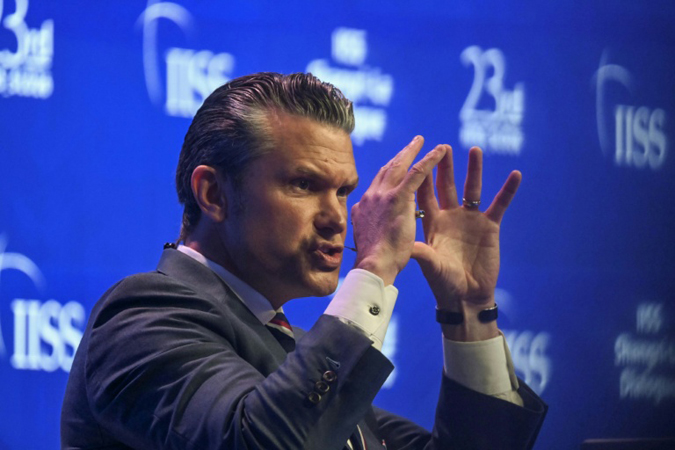
 US Defence Secretary Pete Hegseth has publicly distanced himself from a previous intelligence assessment that named Pakistan’s long range ballistic missile programme as a potential threat to the American homeland, saying Washington is “not pointing a finger” at either India or Pakistan and is instead grateful for their recent roles in peace efforts.
During a panel discussion at Singapore’s Shangri La Dialogue over the weekend, Hegseth was asked about remarks made to the US Senate Intelligence Committee on March 18, 2025, by Director of National Intelligence Tulsi Gabbard, who listed Pakistan’s missile development alongside those of Russia, China, North Korea and Iran as systems that “put our homeland within range”. She had then cited the 2026 Annual Threat Assessment, which said Pakistan was advancing missile technology that could eventually lead to intercontinental ballistic missiles (ICBMs) capable of striking the United States. The report had also warned that India Pakistan relations remained a risk for nuclear conflict.
In his response, Mr Hegseth described such concerns as misplaced.
“I think both sides there are going to see understandable threats coming from the other, maybe some of which we see differently, and countries are going to want to develop ICBM threats, but we’re not pointing a finger, at least from our view, at either country and calling them a threat to us,” he said. He added that Washington was “grateful” for the “benefits they’ve given to peace around the world”.
The defence secretary’s remarks mark a sharp shift in US policy, being read as evidence that Pakistan’s recent diplomacy is altering perceptions in Washington. Pakistani officials are receiving appreciation from world leaders for their unrelenting hard work as they sought to position the country as a responsible mediator in back channel talks between the United States and Iran on a potential settlement to the ongoing conflict in the Gulf.
Hegseth explicitly praised Prime Minister Shehbaz Sharif and Field Marshal Asim Munir for their roles, saying the United States saw an “unexpected development and a true friendship” with Pakistan, again drawing a parallel:
“I mentioned India here (in his speech), but I very easily could have mentioned Pakistan and the role that the field marshal and the prime minister are playing in peace negotiations.” In his prepared address, the defence secretary had also described India as “a critical anchor to hold the line” in South Asia.
Washington remained committed to its Indo Pacific strategy, he said, but there was room for cooperation with Pakistan in other theatres.
The defence chief also repeated President Donald Trump’s claim that he had played a direct role in defusing a flare up between India and Pakistan in May 2025. He said that both countries were “nuclear capable” and that the president had helped broker a ceasefire. Meanwhile, New Delhi has consistently rejected that contention, saying any halt was agreed bilaterally through contacts between the two countries’ directors general of military operations.
Munir and Sharif built a rapport with Trump during US efforts to defuse a brief but intense conflict between Pakistan and India last year, which involved exchanges of drone, missile and artillery strikes between the two nuclear-armed neighbors.
Pakistan hailed Trump’s role following the conflict, with Sharif nominating him for the Nobel Peace Prize, while India dismissed US involvement in resolving the standoff.
Munir and Sharif’s ties with Trump deepened after the US-Israeli war on Iran in February. Pakistan played a leading mediating role between Washington and Tehran by hosting the first round of peace talks. Munir also visited Tehran to help ease Middle East tensions and broker an extension of the ceasefire.
Welcoming the defence secretary’s remarks as vindication of their diplomatic efforts, sources in Islamabad pointed out that they came just hours after Deputy Prime Minister Ishaq Dar’s meeting in Washington with Secretary of State Marco Rubio. A diplomatic source further said Hegseth’s comments suggested the Pentagon was more receptive to Islamabad’s role than the US intelligence community appeared to be in March.
Analysts in Pakistan have unfailingly pushed back against the March intelligence assessment, noting that India possesses longer-range missile capabilities and, by contrast, Pakistan’s missile programme remains India-focused. Previously, the Foreign Office had also rejected this assessment, saying its strategic capabilities were “exclusively defensive” and rooted in “credible minimum deterrence” vis-à-vis India.