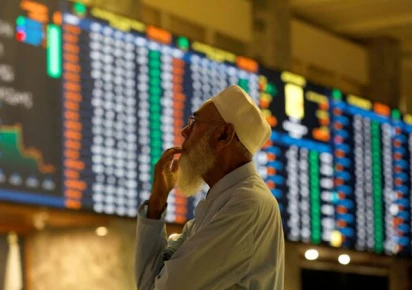
Pakistan’s stock market opened the week under severe pressure as investors reacted sharply to rising geopolitical tensions in the Middle East and increasing uncertainty over Pakistan’s monetary policy outlook. Consequently, the benchmark KSE-100 index plunged more than 13,000 points during early trading on Monday, signaling one of the sharpest market declines in recent months. The massive fall reflected growing anxiety among investors who quickly pulled funds from equities amid fears of economic instability and potential policy tightening. As uncertainty deepened, trading activity briefly halted after the market recorded a drop exceeding 10,000 points during the session.
The KSE-100 index eventually shed 13,109.39 points, pushing the benchmark down to 144,386.71 points compared with the previous close of 157,496 points. This sharp fall represented a negative change of approximately 8.32 percent, highlighting the scale of investor panic across multiple sectors of the market. Moreover, analysts noted that investors adopted a cautious approach as concerns grew over a possible increase in the policy rate aimed at controlling inflation and stabilizing the currency. As a result, heavy selling pressure dominated trading activity throughout the session.
Read more : PSX extends losing streak as KSE-100 drops 3715 points
At the same time, global oil markets experienced dramatic movements as geopolitical tensions intensified following the expanding conflict involving the United States, Israel, and Iran. Oil prices surged nearly 20 percent on Monday, reaching their highest levels since July 2022 amid fears of significant supply disruptions. Furthermore, concerns grew over the safety of shipping routes through the Strait of Hormuz, one of the world’s most critical oil transport chokepoints. These developments triggered strong reactions in global energy markets and added further pressure on emerging economies dependent on imported fuel.
Meanwhile, several Middle Eastern producers began cutting energy output as the conflict disrupted regional supply chains and created uncertainty around production stability. Iraq and Kuwait initiated reductions in oil output, while Qatar had already announced earlier cuts in liquefied natural gas shipments due to logistical challenges. Analysts also warned that the United Arab Emirates and Saudi Arabia could soon follow with similar production cuts if storage capacities tighten and disruptions continue. Such developments may further tighten global energy supplies and sustain upward pressure on oil prices.
Read more : Bloodbath at PSX as index sheds 16,089 points over ME tensions
Brent crude futures jumped as much as $18.35, representing a 19.8 percent increase, briefly reaching $111.04 per barrel before stabilizing near $107.93 during early Monday trading. Similarly, U.S. West Texas Intermediate crude futures rose about $16.50, or 18.2 percent, trading around $107.40 per barrel after earlier touching $111.24. Notably, the previous week had already seen strong gains, with Brent climbing roughly 27 percent and WTI advancing 35.6 percent. Therefore, economists warn that prolonged tensions could lead to weeks or even months of elevated fuel prices worldwide.
As global energy markets remain volatile, economists believe the ripple effects could spread across international economies, especially those heavily dependent on imported oil and gas. Higher fuel prices typically raise transportation and production costs, which eventually push inflation upward and slow economic growth. Consequently, policymakers across many countries may face difficult choices between controlling inflation and supporting economic activity. For Pakistan, the combination of rising oil prices and financial market instability may create additional challenges for economic stability in the coming months.