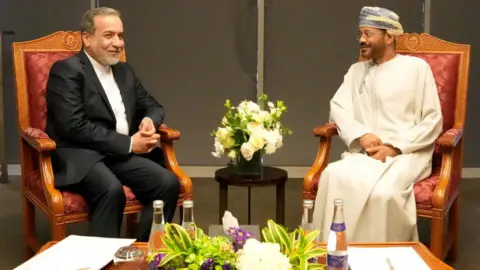
OMAN/WASHINGTON: Iran and the United States (US) began high-stakes negotiations in Oman on Friday to resolve long-standing disputes over Tehran’s nuclear programme. However, differences over the agenda and additional issues threaten to derail diplomacy and escalate regional tensions.
Read More: Oman hosts crucial US–Iran talks amid rising tensions
While both sides have expressed willingness to engage, Washington has pushed to expand talks to include Iran’s ballistic missiles, regional military activities, and human rights concerns, according to US Secretary of State Marco Rubio. Tehran, however, insists that discussions remain limited to the nuclear issue, with Foreign Minister Abbas Araqchi and US Middle East envoy Steve Witkoff leading the talks.
🚨 TALKS ENDED — BUT NOTHING WAS SOLVED
Indirect U.S.–Iran nuclear talks in Muscat wrapped up as a U.S. convoy left the site, ending another session that began this track back in April 2025. No deal. No breakthrough. Just an exit.
Why skepticism is loud:
Oman has hosted talks… pic.twitter.com/tBrjpg5D5v— Naeem Aslam (@NaeemAslam23) February 6, 2026
“Iran enters diplomacy with open eyes and a steady memory of the past year. We engage in good faith and stand firm on our rights. Commitments need to be honoured,” Araqchi said on social media Friday.
Tensions are further heightened by a recent US naval buildup near Iran, which President Donald Trump has called a massive “armada.” The presence of US forces comes in the wake of a deadly government crackdown on protests in Iran last month. White House Press Secretary Karoline Leavitt emphasized that the president retains “many options… aside from diplomacy,” heightening concerns of potential military escalation.
Iran has warned of a harsh response to any strike, cautioning neighboring Gulf Arab states that host US bases that they could be targeted. Tehran has also deployed the Khorramshahr-4 long-range missile at a Revolutionary Guards’ underground facility, signaling its deterrence capability.
Read More: US signals diplomacy first as Trump warns Iran of military options
Despite these tensions, Iran has shown some flexibility on uranium enrichment, including proposals to hand over 400 kg of highly enriched uranium and accept zero enrichment under a consortium arrangement. Yet, it maintains that its right to enrich uranium and the lifting of sanctions are non-negotiable.
The talks in Oman are seen as a critical test for both sides. Failure to reach an agreement risks renewed military confrontation in a volatile Middle East, while a successful outcome could restore elements of the 2015 nuclear deal, limiting Iran’s nuclear capabilities.