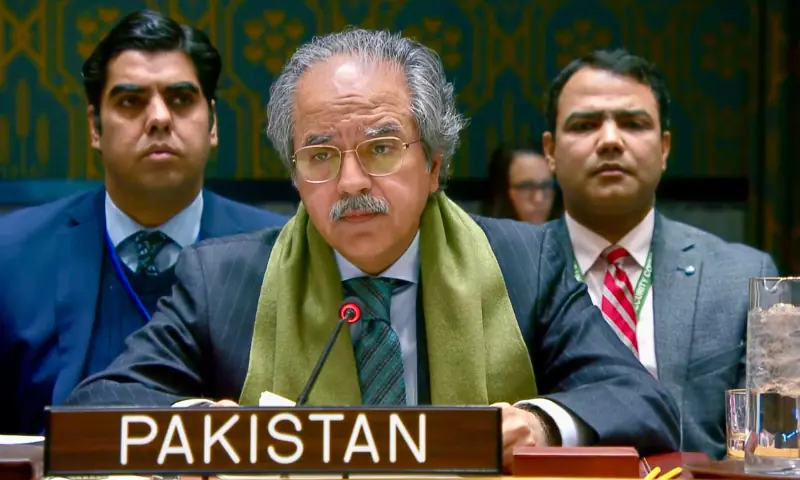
WASHINGTON: Pakistan vowed on Monday to prevent the desertification of its fertile plains, condemning India’s unilateral suspension of the Indus Waters Treaty (IWT) as “a blatant breach of international obligations” during a high-level debate at the UN Security Council.
Read More: Pakistan warns UN over Indus Waters Treaty
Speaking at the session, Pakistan’s UN Ambassador Asim Iftikhar Ahmad said the treaty’s compliance is “a cornerstone of the international legal order” and warned against the “weaponisation of water and other natural resources.” He stressed that Pakistan would counter India’s latest provocation — described as “water terrorism” — with the same resolve and clarity it demonstrated during last May’s conflict.
Sermons on law, justice and fairness ring hollow, in fact comical, from a country which is peddler of lies, planner of global assassination campaigns and a plotter of terrorism in the region and beyond. So much so it doesn’t even shirk from politicizing a field as innocuous as… pic.twitter.com/jHRWduer3c
— Permanent Mission of Pakistan to the UN (@PakistanUN_NY) January 26, 2026
Ambassador Ahmad recalled India’s May 10, 2025, military aggression, stating that Pakistan acted in self-defense under Article 51 of the UN Charter, and emphasized that respect for international law remains the only legitimate standard for inter-state conduct.
Statement by Ambassador Asim Iftikhar Ahmad,
Permanent Representative of Pakistan,
At the High-Level Open Debate of UN Security Council on “Reaffirming International Rule of Law: Pathways to Reinvigorating Peace, Justice, and Multilateralism”
(26 January 2026)
*****Mr.… pic.twitter.com/HBMoHXHdLg
— Permanent Mission of Pakistan to the UN (@PakistanUN_NY) January 26, 2026
Responding to India’s threats, Pakistan’s representative Zulfiqar Ali said the IWT suspension could lead to the desertification of Pakistan’s ancient fertile plains. He described India’s claims as “spurious” and part of a longstanding effort to divert attention from its occupation of Jammu and Kashmir, calling India’s international rhetoric “hollow” in light of alleged domestic and regional abuses.
Ambassador Ali also criticised India’s internal policies, highlighting discrimination and attacks against religious minorities, including Muslims, Christians, and Sikhs, and dismissed New Delhi’s claims of democratic governance as inconsistent with these actions.
Read More: At UN, Pakistan slams India for water weaponisation
During the debate, India’s envoy Parvathaneni Harish reiterated New Delhi’s stance that the treaty would remain in abeyance until Pakistan ceased alleged support for cross-border terrorism. Pakistan’s representatives rejected these allegations, citing multiple independent assessments supporting Islamabad’s position and asserting their capability to thwart any future attempts to exploit water resources as a political tool.