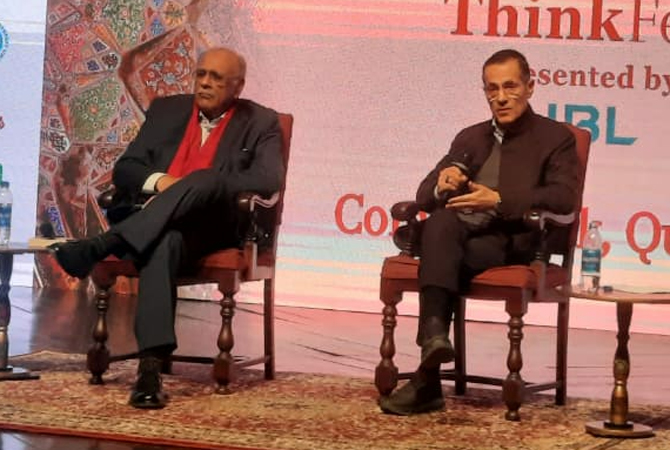
 The 9th edition of Think Fest “Afkar-e-Taza” kicked off at the Lahore Arts Council Alhamra with great intellectual fervour and cultural vibrancy, marking a powerful beginning to one of Pakistan’s most influential platforms for ideas, dialogue and global thought.
From its very first day, Think Fest reaffirmed its stature as a forum where history, politics, literature, climate and global affairs converge under one roof.
The opening day commenced with a specially curated exhibition titled “Maharaja Ranjit Singh’s Toshakhana,” curated by Nadra Shehbaz Khan and Murtaza Taj, which set a reflective and historically rich tone for the three-day festival. The exhibition attracted scholars, students, diplomats and art enthusiasts, offering a rare visual and cultural insight into a significant chapter of South Asian history.
Simultaneously, a series of high-profile sessions unfolded across Alhamra Hall No. 2, Hall No. 3 and the Alhamra Adbi Baithak, engaging audiences in critical global and national conversations. In Hall No. 2, the session “The Gaza War and the Remaking of the Middle East” brought together senior analyst Najam Sethi and renowned global scholar Vali Nasr from Johns Hopkins University, USA, setting the intellectual tempo of the festival. This was followed by “Pakistan: Between the US and China,” featuring Vali Nasr, former Foreign Minister Hina Rabbani Khar and noted scholar Raza Rumi, offering nuanced perspectives on shifting global alliances. The day continued with “Is Climate Governance Working in Pakistan?”, where Zulfiqar Ali Bhutto Jr., Hammad Naqi (WWF Pakistan) and Maliha Sattar (ITU) addressed pressing environmental challenges.
At Alhamra Hall No. 3, parallel sessions added further depth to the discourse. “An African History of Africa” featured Zeinab Badawi of SOAS, University of London, alongside historian Ammar Ali Jan, while “Literature as Resistance” brought compelling reflections from acclaimed writer Mohammed Hanif and Shahista Sonu Sarajuddin.
The Alhamra Adbi Baithak hosted equally significant conversations, including “Child Protection and Interventions Against Early Marriage in Pakistan,” with Jennifer Milton (UNESCO), legal expert Sarah Mallickani, and Oxford-affiliated scholars Muhammad Faisal Khalil and Justin Jones. The opening day concluded with “Beyond Gunpowder: Re-thinking Mughal Military History,” featuring Joyce Gomes from Leiden University, Netherlands, and Ali Jibran Siddiqi (IBA Karachi), presented with the support of the Royal Netherlands Embassy.
Speaking on the occasion, Chairman Alhamra Razi Ahmed emphasized that Alhamra remains committed to hosting platforms that challenge minds, inspire debate and nurture informed citizenship. In his remarks, Executive Director Alhamra Muhammad Nawaz Gondal said Alhamra will continue to provide its stage, resources, and institutional support to initiatives that promote knowledge, culture and progressive thought at the national and international level.
The vibrant opening day of Think Fest “Afkar-e-Taza” at Alhamra set a commanding tone for the days ahead, reinforcing Alhamra’s role as Pakistan’s leading cultural institution and a global hub for dialogue, reflection and ideas.