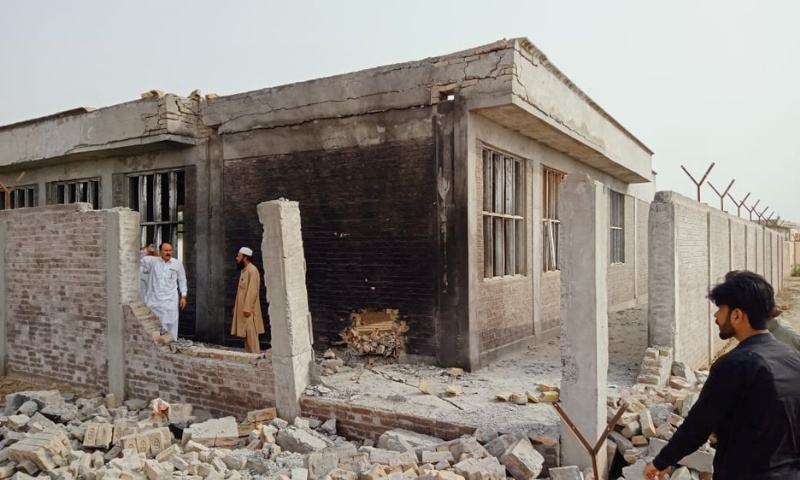
TAUNSA: A government girls school in the tri-border region of Taunsa district was partially damaged in an improvised explosive device (IED) blast during the night of January 7–8. The incident occurred at the Government Girls Primary School in Basti Jooter, Koh-i-Suleman tehsil, Northern Tuman Qaisrani, located along the sensitive Punjab-Khyber Pakhtunkhwa-Balochistan boundary.
Read More: Dozens injured in blast near Jakarta school
Authorities said the attack was carried out by Fitna al Khawarij, affiliated with the Tehreek-i-Taliban Pakistan (TTP) / FAK (South Waliya Punjab). The explosion near the school building caused the collapse of a boundary wall, veranda, washroom, and one classroom, partially destroying the structure and disrupting academic activities.
🚨🚨
Government Girls School in Punjab’s DG Khan District Hit by ExplosionRead more: https://t.co/eoPqFO1HRt pic.twitter.com/BeUksZQ2dH
— The Khyber Chronicles (@TKCkhyber) January 9, 2026
The school, operating under Phase-I of the Punjab Education Foundation (PEF) through an outsourced licensee, had 134 students enrolled and four teachers on staff. Since the area was on winter vacation until January 11, no casualties were reported, but authorities warned of the potential for serious harm had students been present.
The region falls under the jurisdiction of the Border Military Police (BMP), and two security check-posts have been established at Lakhani and Jungi. Over 100 personnel are deployed at each post to secure the area, and a search operation was launched immediately following the blast.
Dera Ghazi Khan District Police Officer Sadiq Baloch said bomb disposal and investigation teams had collected evidence from the site. He added that officials were working to determine the precise circumstances of the attack and to prevent similar incidents in the region, which remains highly sensitive due to its location near provincial borders.
Read More: Two children killed, several injured in Mir Ali seminary blast
Authorities condemned the attack as an attempt to intimidate local communities and disrupt education, reaffirming their commitment to maintaining security in border districts.