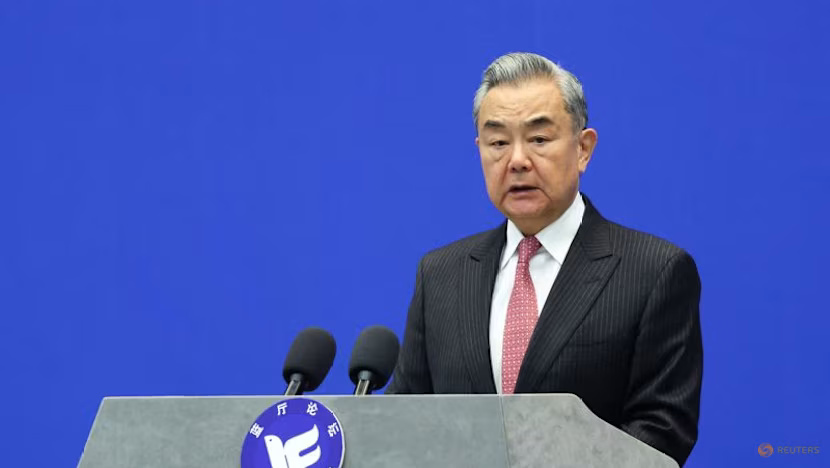
China on Tuesday vowed to “forcefully counter” United States arms sales to Taiwan, as Foreign Minister Wang Yi accused Washington of interfering in Beijing’s core national interests and warned that any attempt to block reunification would fail. His remarks came amid heightened military activity around the self-ruled island.
Read More: US announces over $10 billion arms sales package for Taiwan
Speaking at an annual international relations symposium in Beijing, Wang portrayed China as a stabilising force in a turbulent world. He criticised tariff wars and disruptions to global trade, saying economic globalisation had suffered severe setbacks this year, while positioning Beijing as an “anchor of stability” in global affairs.
Without naming the United States directly for trade tensions, Wang said cooperation between Beijing and Washington benefited both sides, whereas confrontation harmed them. He stressed that the China-US relationship remained one of the most important in the world, but cautioned against actions that challenged China’s sovereignty and territorial integrity.
His comments followed Taipei’s announcement earlier this month that Washington had approved an $11 billion arms package for Taiwan. The decision angered Beijing, which regards Taiwan as part of its territory and has repeatedly opposed foreign military support for the island.
“In response to continuous provocations by pro-independence forces in Taiwan and large-scale US arms sales, we must resolutely oppose and counter them,” Wang said. He added that any attempt to obstruct China’s unification with Taiwan was “doomed to failure”.
The diplomatic warning coincided with fresh Chinese military drills near Taiwan. China’s People’s Liberation Army said it conducted live-fire exercises north of the island, including missile launches, fighter jet operations and naval deployments aimed at simulating a blockade and strikes on maritime targets.
Read More: China intensifies military drills near Taiwan
Journalists on Pingtan island, the closest point on the Chinese coast to Taiwan, reported seeing multiple rockets launched in quick succession. Taiwan’s authorities said they detected dozens of aircraft and vessels, and counted at least 27 rockets fired during the drills.
Wang also highlighted President Xi Jinping’s recent visits to Southeast Asia and Russia as evidence of China’s growing regional engagement. He cited Beijing’s role in mediating regional disputes and supporting diplomatic efforts in other conflict zones as part of its broader foreign policy approach.