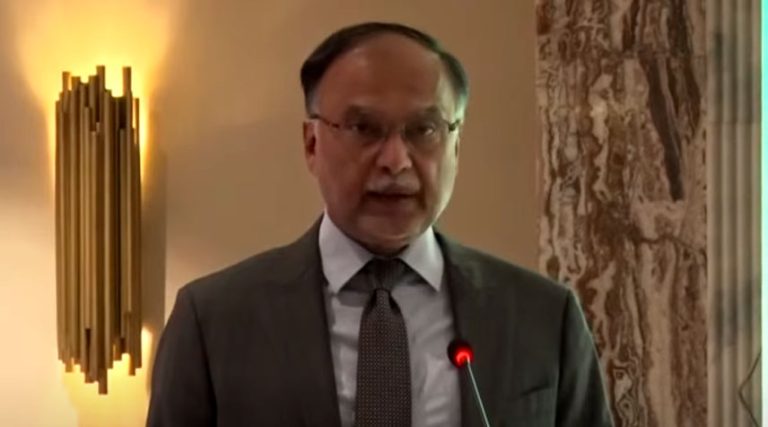
Federal Planning Minister Ahsan Iqbal said on Thursday that Pakistan’s major challenges stem not from a shortage of resources, but from persistent political instability, policy inconsistency and weak institutions. He stressed that neglect of education, lack of discipline and poor governance have continued to hold the country back.
Read More: Pakistan back on track of stability, development: Ahsan Iqbal
The minister was speaking at a ceremony held at the Convention Centre to formally launch year-long nationwide celebrations marking 2026 as the ‘Year of Quaid-i-Azam’. The event, titled Quaid’s Pakistan — Uraan Pakistan, featured youth video messages, panel discussions with scholars and policymakers, and performances of national songs.
پچھلے تین سالوں سے پی ٹی آئی کے خلاف اسٹیبلشمنٹ کی جانب سے جو ظلم، جبر اور سیاسی انتقام جاری ہے، ن لیگ نہ صرف اس سب کی حمایت کرتی رہی ہے بلکہ کھلے عام یہ کہتی رہی ہے کہ انہیں مزید مارو، کچلو اور ختم کر دو۔
اس کے باوجود ہم احسن اقبال پر ہونے والے تشدد کی شدید مذمت کرتے ہیں، کیونکہ… pic.twitter.com/OBgcZjqd7P— Hukam Saeed (@HukamSaeed) December 26, 2025
Addressing the gathering, Ahsan Iqbal said the occasion was meant to encourage national reflection rather than serve as a symbolic celebration. He introduced Uraan Pakistan as an execution framework designed to translate Quaid-i-Azam Mohammad Ali Jinnah’s vision into a modern development strategy aimed at building a competitive, knowledge-based and trillion-dollar economy.
He explained that the initiative is built on five key pillars: exports, e-Pakistan, equity and empowerment, environment and climate change, and energy and infrastructure development. According to the minister, consistent policies and collective national effort are essential to achieving sustainable social and economic progress.
Ahsan Iqbal said rebuilding Pakistan in line with Quaid-i-Azam’s principles was the need of the hour. He noted that the Founder of the Nation reshaped history not through inherited power or military strength, but through constitutional struggle, moral courage and strong character.
Reflecting on Pakistan’s 77-year history, the minister said the country had experienced both success and hardship. He added that challenges should be treated as opportunities to strengthen stability and growth rather than sources of division.
Read More: Economic revival hinges on political stability, says Ahsan Iqbal
Outlining Quaid-i-Azam’s vision, he said Pakistan was meant to be a democratic, inclusive and merit-based state with equal rights for minorities, rule of law and impartial institutions. He warned that corruption, nepotism, intolerance and disorder were identified by Jinnah as the greatest threats to national survival.