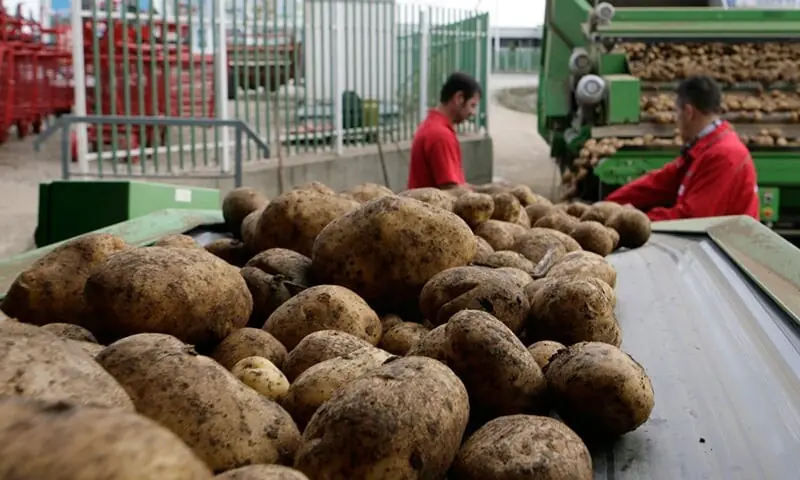
ISLAMABAD: Pakistan’s potato market suffered a severe crash last week as a growing supply glut coincided with the closure of the Afghan border. Farmers and stockists are offloading stored potatoes, intended for both exports and domestic consumption, at prices that fail to cover transportation and cold storage costs.
Read More: China a potential market for Pakistani potatoes: experts
The new crop from Khyber Pakhtunkhwa and Punjab’s Soon Valley has also entered the market, trading at nearly half of last year’s prices. The closure of the Afghan border in October has halted both direct exports to Afghanistan and the vital transit trade to Central Asian states and Russia.
Historically, Afghanistan has been Pakistan’s largest potato market, importing over 40% of Pakistan’s exports in recent years. Analysts say the heavy dependence on a single, unstable market exposes chronic structural weaknesses in the country’s agriculture and trade policies.
This is the #Peshawar vegetable market; traders say their produce isn’t selling and much of it has gone to waste.
We sympathize with the Pakistani traders, but we tell them that you are suffering because of what you see as Asim Munir’s incompetent behavior.
Had you not blocked… pic.twitter.com/oyWri8s7Ke— Inside Afghanistan (@A_Observer313) November 30, 2025
The oversupply and declining prices threaten the livelihoods of farmers cultivating nearly one million acres of potatoes. With no immediate access to alternative export markets, the sector faces mounting losses. Experts warn that the glut is likely to repeat next year unless strategic interventions are implemented.
Economists and agriculture specialists suggest several measures to stabilise the sector. These include rerouting exports through Iran, exploring new markets, and promoting import-substitution for crops in deficit, such as chickpeas and pulses. Cluster-based contract farming is recommended to align production with market demand, while value addition and processing can help absorb surplus and reduce post-harvest losses.
Read More: Market Committee issues price list of fruits, vegetables
Policy analysts emphasise that long-term stability in the potato sector will require data-driven crop planning, market diversification, and government support to modernise storage, logistics, and value-added operations. Without timely action, the recurring oversupply could suppress GDP growth, deepen poverty, and perpetuate losses for farmers already struggling under current market conditions.