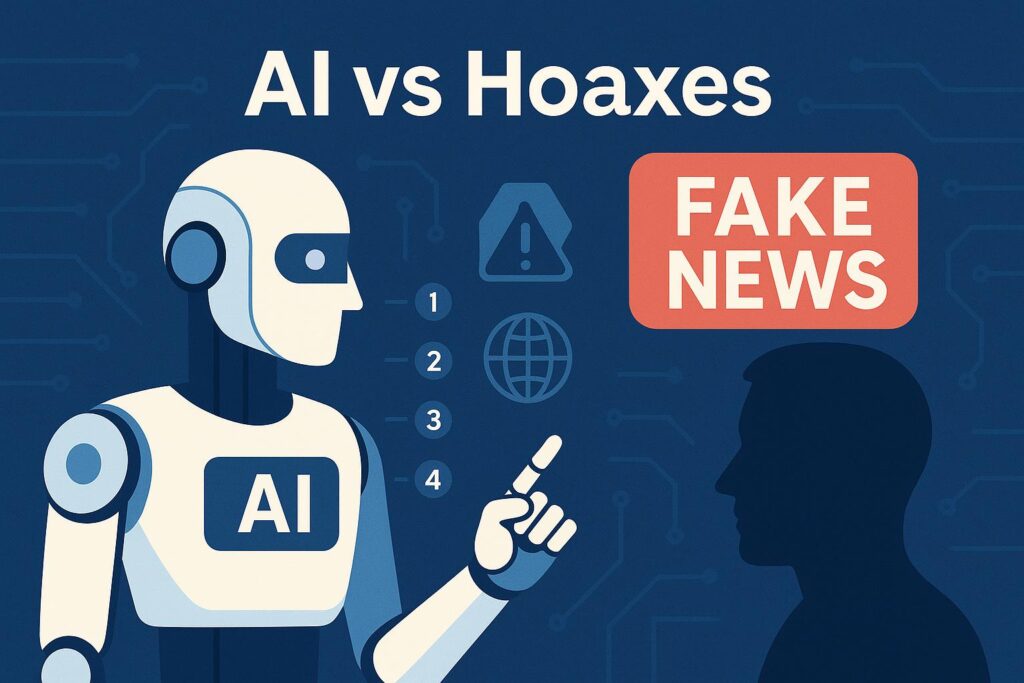
We all want to make sense of the world around us—whether it’s understanding the war in Gaza, the state of our healthcare system, or even changes to a bus route that affect our daily lives. For that, we rely on news we can trust. But today, trust is under threat like never before.
Artificial intelligence now produces information so convincingly that it blurs the line between truth and fabrication. Astonishing clips and viral stories spread rapidly across feeds, but what’s real and what’s AI-made is increasingly difficult to tell. And when people can’t agree on what’s true, conspiracy theories grow, societies polarize, and democracy itself is weakened.
Original research by the BBC this year revealed that half of AI-generated answers to news-related questions were flawed—missing key details, misquoting sources, or distorting facts. Unlike a misstep in a recipe or travel tip, errors in news matter deeply, because they shape public understanding and political choices.
Meanwhile, journalism—the product of careful investigation, verification, and accountability—is being quietly eroded. News content is scraped without consent, repackaged by algorithms, and redistributed without credit or compensation. These subtle distortions are far more dangerous than obvious deepfakes because they are plausible and misleading, corroding already fragile public trust.
Journalists and media organizations worldwide are calling for urgent reform. The European Broadcasting Union and WAN-IFRA, alongside thousands of newsrooms, are urging AI developers to adopt five clear principles:
AI systems must not be trained on news content without permission; creators deserve compensation; sources must be cited with transparency; AI must support diversity in journalism; and above all, tech companies must work with journalists, not exploit them.
Responsible use of AI in journalism is possible. Many outlets are already using it ethically—for translations, misinformation detection, and tailored content—without compromising editorial integrity. But ethical standards must be enforced before AI undermines trust in everything we read, hear, or watch.
This is not a distant concern. The internet is already flooded with synthetic fakery designed to deceive, profit, and manipulate. If left unchecked, AI will not only distort the news—it will erode society’s very ability to distinguish truth from lies.
Trust cannot be built on words alone. The leaders of the AI revolution must act now to ensure their tools strengthen, rather than sabotage, the public’s right to reliable information. Without corrective action, the danger is clear: a world where truth is impossible to discern, and democracy becomes the ultimate casualty.
Liz Corbin is Director of News at the European Broadcasting Union. Vincent Peyrègne is CEO of WAN-IFRA, the World Association of News Publishers. This article is part of a special series for World News Day, September 28.