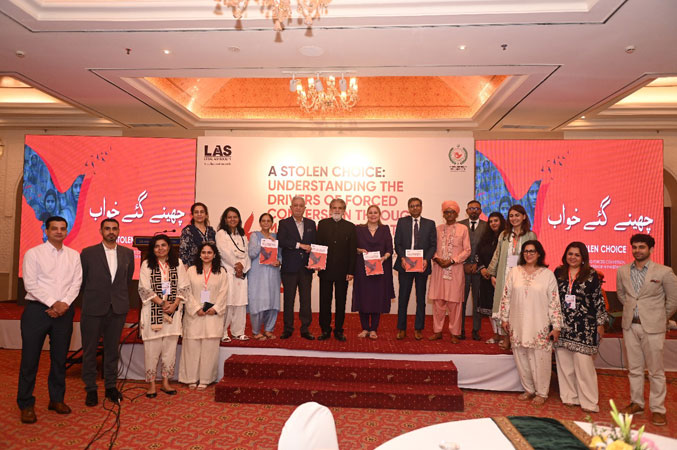
 National Commission for Human Rights (NCHR), in collaboration with Legal Aid Society (LAS), has launched a comprehensive documentary and research report to understand the drivers of forced conversion through marriages (FCM) and its multidimensional impact on survivors, religious minority communities (RMCs), and Pakistani society.
The research report and the documentary were launched on Monday at a national dialogue organised to discuss the drivers of FCM. The report presents firsthand accounts from survivors of FCM and clarifies the definitions of forced conversion through marriage, enhancing understanding of the concepts of “force” and “consent.” The event brought together legal experts, minority rights activists, and criminal justice professionals to explore actionable steps to tackle the pressing issue of FCM. Justice Dr. Syed Muhammad Anwer was the chief guest on the occasion.
The event started with the opening remarks by CEO of LAS Haya Emaan Zahid, followed by remarks from Chairperson NCHR Rabiya Javeri Agha. Later, Maliha Zia, Director LAS, presented an overview of report’s findings. The event included a documentary screening focused on FCM by Aisha Gazdar (Filmmaker) Produced by Bond Advertising, and an interactive panel session led by Maliha Zia from LAS.
Panellists engaged in meaningful discussions, shared insights and experiences that will contribute to ongoing efforts to protect and promote the rights of religious minorities in Pakistan. This provided a collaborative environment for service providers to address the pervasive issue of FCM in Pakistan and promoted discourse development on FCM.
Speaking on this occasion, Chairperson National Commission of Human Rights (NCHR) Rabiya Javeri Agha said the issue of FCM is a pervasive and deeply entrenched problem in Pakistan, disproportionately affecting girls and women from religious minority communities. “Despite existing constitutional and legal frameworks aimed at protecting religious freedom, FCM persists due to a complex interplay of socio-cultural, economic, and political factors, reflecting systemic vulnerabilities and societal pressures,” she said.
Chairperson NCHR said that the Commission has taken various Suo Motu notices of FCM cases, in which minor girls and women were abducted, forced to convert to Islam and married off to their abductors. “However, relief has been provided to the victims and their families due to the intervention of the NCHR.”
In her opening remarks, CEO LAS Haya Emaan Zahid said that the impact of FCM are severe with victims suffering from psychological trauma, physical and sexual abuse and social stigmatisation. “This practice not only devastates individual but also undermines the fabric of communal solidarity and cultural heritage within religious minority communities, eroding their ability to practice and propagate belief.”
The research report divides drivers of FCM into two categories including motivations of perpetrators and vulnerabilities of survivors. The motivations of perpetrators are explained in the light of influence of religious duty and ideological convictions, ideologically motivated sexual grooming, trafficking and prostitution, sexual motivations and power dynamics, impunity for perpetrators of FCM, and glorification and sensationalization in media.
The report highlights the vulnerabilities of survivors into four different sub-categories: cognitive vulnerability of children to sexual violence and forced marriage, adolescence, rebellion and risk-taking stage of girls exploited by predators, gender-specific vulnerabilities of women, and the intersection of socio-cultural and economic factors.