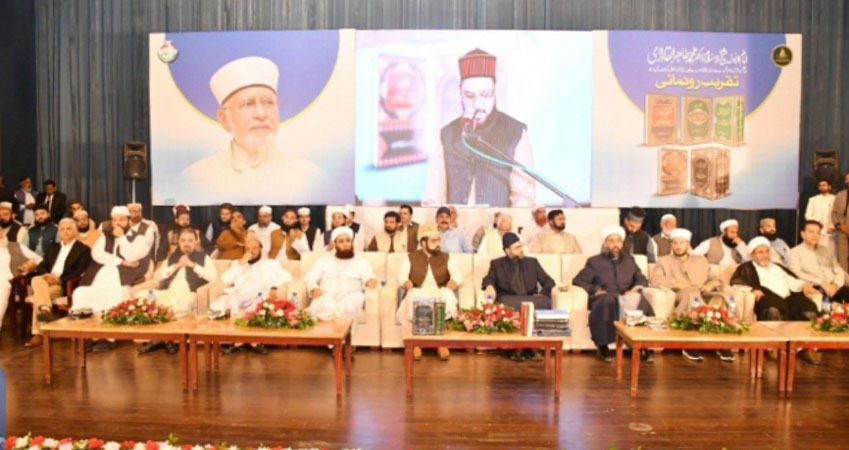
 The Pak-China Friendship Center, long known as a hallmark of Pakistan-China ties, on Wednesday also became a symbol of interfaith harmony and sectarian cohesion, as scholars, researchers, and spiritual leaders from diverse schools of thought gathered on a single platform for the launch of five major new works by Shaykh-ul-Islam Dr. Muhammad Tahir-ul-Qadri.
The event, organized by Nizam-ul-Madaris Pakistan at the Pak-China Friendship Center, featured the unveiling of Dr. Qadri’s latest volumes on Qur’anic exegesis, principles of Tafsir, Hadith, and Seerah. Eminent ulema, mashaykh, academics, and professionals from across the country praised Dr. Qadri’s intellectual, spiritual, and humanitarian contributions.
Speakers said Dr. Qadri had set a practical example of women’s participation in Islamic scholarship alongside men and had guided the Ummah by exposing terrorism and the ideology of Khawarij at a critical time. They noted that his works cover every vital issue of the age, providing intellectual and spiritual guidance to promote unity in times of confusion and division.
Justice Anwar called Dr. Qadri’s writings “a model of research and inquiry, proof that the fountains of knowledge are still alive,” while Maj. Gen. (R) Ghulam Qamar said he “fearlessly raised his voice against extremism when it was most difficult.”
Dr. Abu Bakar of IIUI said Dr. Qadri presented “the clearest and most reasoned framework for Islamic banking, proving it a practical reality.” Pir Ali Raza Bukhari described the new publications as “a revolution that inspires transformation in young hearts,” while Advocate Naeem Gujar highlighted Minhaj-ul-Quran’s humanitarian services, such as free funeral and burial facilities for Muslims in the UK.
Professors Aftab Alam, Mohiuddin Hashmi, and Saleem Mazhar noted that the works meet international academic standards and embody moderation, tolerance, and intellectual resistance against extremism.
Speakers agreed that the Pak-China Friendship Hall has now become “a symbol of interfaith harmony, sectarian unity, and intellectual cooperation based on knowledge.”