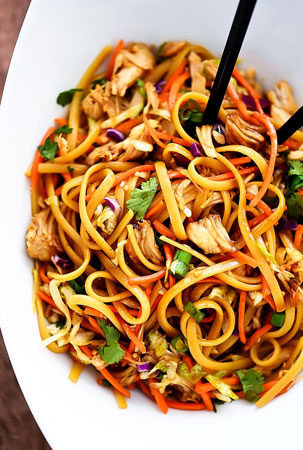
 In Thailand, pad thai, pad see ew and pad kee mao are just three of countless popular noodle dishes. But at Thai restaurants elsewhere, they are canon. “Those are the three noodles that everyone who’s been to Thailand wants to make,” said Watcharee Limanon, who has moved between Bangkok and the United States since 1994, and built a small Thai culinary empire from her home in Yarmouth, Maine.
These dishes are especially popular, said Limanon, not only because they are widely available, extremely inexpensive and legendarily delicious. It is also because they have built-in “rot chaat dee” – the balance of tastes, textures and flavours that Thai cooks – and fans of Thai food – appreciate.
“You know how caramel cheese popcorn is a perfect food?” said Pailin Chongchitnant, a chef in Vancouver, British Columbia. “The sweet makes you crave salt, and the salt makes you crave sweet.” In Thai, she said, “glom glom” is the term for that can’t-stop-eating-it quality. “That’s what a really good pad see ew is like,” she said.
Even for expert Thai cooks, getting these dishes just right in a home kitchen doesn’t come easily. Noodle stir-fries are classic street food, cooked to order by vendors who can wield giant woks and dip into dozens of bowls of ingredients. But for those who live abroad, home cooking is often the only way to satisfy their cravings.
As a longtime seeker of perfect stir-fried noodles, I asked Limanon and other cooks how they adapt these dishes for their own kitchens, with local ingredients, appliances and challenges.
First off: A wok isn’t always the right tool for the job.
The tiny Manhattan apartment that chef Hong Thaimee first moved into had a tiny stove without a single powerful burner. So she long ago started using her robin’s-egg-blue Dutch oven for stir-fries.
“Even if you can get a wok hot enough to sizzle, adding the ingredients cools it way down,” she said. “What you need is a pan that holds onto heat,” with a flat bottom that comes into direct contact with the flame.
Although finding “authentic” ingredients can be a challenge, insisting on authenticity is often counterproductive, said Chongchitnant, who posts detailed recipe videos on her popular YouTube channel, “Hot Thai Kitchen.” “People in Thailand are always playing around with the recipes anyway,” she said.
Chongchitnant grew up in Hat Yai, near the southern border with Malaysia, where she ate pad see ew made with egg noodles instead of the standard rice ones; later, the family moved to Bangkok, where restaurants advertise their use of spaghetti and linguine. Although the original dish is made with beef – it is related to Chinese chow fun – she said that chicken and pork are just as popular in Thailand.
In North America, if she can’t find gai lan, Chinese broccoli, she uses broccolini, or cuts broccoli into long florets, because the crunch of the thick green stems is what the dish needs. “People assume that a good substitute for an Asian ingredient is another Asian ingredient,” she said, noting that bok choy and Napa cabbage are often suggested – unhelpfully, in her view – as good substitutes for gai lan. “That’s not always true.”
Similarly, she said, non-Thai cooks often assume that the best substitute for holy basil is Thai basil – but Italian basil is often a closer flavour match.
Jam Sanitchat has a restaurant in Austin, Texas, called Thai Fresh, that also functions as a cooking school, a market and a vegan ice cream shop. She said that on principle, despite demand from vegan and vegetarian locals, she couldn’t bring herself to make pad thai entirely without fish sauce. “I refused for a long time,” she said. But eventually she decided that the central role of condiments – the ubiquitous fish sauce, chili powder, lime wedges, pickled chiles and more – proves that in Thailand, taste is sometimes more important than tradition.
“A French chef would never let you season his food,” she said. “We are much more open to choice.” Understanding ingredients can be a challenge, especially for cooks who are unfamiliar with, say, the entire array of Asian soy sauces. Thai black soy sauce has a complex umami sweetness; some brands of Chinese black soy sauce are a good match for it, but others are much more salty. The solution, Sanitchat said, is to always season lightly, then taste.
A sauce that has tipped over into excess saltiness can be corrected with brown sugar. A too-spicy dish might be asking for a pinch of sugar, or the tartness of tamarind, lime or even straight vinegar. Limanon, who runs Thai cooking classes from her home, guided me through making pad thai. Before the cooking even began, I learned something immeasurably useful: When using dried rice noodles for stir-fries, no matter what the package says, you should never boil them. To stay soft and springy, not mushy, they need to soak in hot water until about 70% of the way to being done.
Although pad thai is the national dish, it is a recent addition to culinary tradition.
Thailand has its own rich and ancient cuisine, but the technique of stir-frying noodles entered the repertoire from China. Pad see ew and pad kee mao have been popular for generations, but retained an identity that was separate from traditional Thai cooking.
After a 1932 coup that shifted the Thai government from an absolute to a constitutional monarchy and a period of devastating rice shortages, the new regime made a push toward nationalism, efficiency and public health. These dovetailed into the official ordination of a new, fully Thai, national dish. Chinese soy and oyster sauces were replaced by fish sauce. The other ingredients chosen were native to the country, shelf-stable or affordable.
Today, there are countless variations of pad Thai around the country. Limanon’s favourite, fragrant with shallots and garlic, is adapted from a recipe once used in the royal palace. Some popular versions are coloured deep orange by the innards of shrimp and crabs, or spiked with red Chile powder. Each serving of pad Thai hor khai, made by the deftest street vendors, is wrapped in a silk-thin omelette.
The regime that came to power in 1932 did not last, but the recipe did. It has rot chaat dee.
“The people would never have adopted it so enthusiastically otherwise,” she said.
RECIPE: SHRIMP PAD THAI
Total time: 45 minutes
For the noodles:
8 ounces sen lek or other pad thai noodles
1/4 cup minced garlic
2 tablespoons minced shallot
1/4 cup minced Thai sweet preserved radish
10 to 12 peeled and deveined medium shrimp
8 ounces superfirm tofu or drained extra-firm tofu, cut into bite-size cubes or rectangles
4 large eggs, lightly beaten
2 cups bean sprouts
1 small bunch garlic chives or scallion greens, cut into 1-inch lengths
3 tablespoons vegetable oil, plus more for cooking eggs
Chopped peanuts, chile powder and lime wedges, for serving
For the sauce:
1/3 cup fish sauce
1/3 cup tamarind liquid or concentrate
1/3 cup coconut or other palm sugar or dark brown sugar
1. Prepare the noodles: Place dried noodles in a large bowl and cover with hot tap water. Let soak for 20 to 30 minutes while you prepare the remaining ingredients, allowing the water to cool, and stirring and separating the noodles occasionally with your hands. When ready, noodles will be white, limp and almost soft to the bite. Pour off all the water, fluff noodles with your hands, and set aside.
2. Meanwhile, make the sauce: Combine the fish sauce, tamarind and coconut palm sugar in a small saucepan. Bring to a simmer over medium heat, stirring often, just until sugar has dissolved, 3 to 4 minutes. Set aside to cool.
3. Line up the ingredients in the order they’ll be cooked: Place the garlic, shallot, radish and shrimp in a bowl, then line up the tofu, noodles, sauce, eggs, bean sprouts and chives. When ready to cook, place 1 cup of hot tap water near the stove.
4. Heat 3 tablespoons of oil in a 14-inch wok, a heavy 12-inch skillet or a large Dutch oven medium-high heat until shimmering. Add the contents of the garlic bowl and stir-fry over medium heat, adjusting the flame so the ingredients are sizzling but not popping or scorching, until the shrimp are nearly pink, 2 to 3 minutes. Add the tofu and stir-fry to heat through, about 2 minutes.
5. Add noodles and raise the heat as high as it goes, tossing and separating them with a wok turner, tongs or both. When noodles are sizzling, add about half the sauce and 1 tablespoon water, and stir-fry, tossing to coat and cook through.
6. Taste a noodle for doneness and seasoning. If needed, add more sauce and water, and keep cooking, turning often, until noodles are softened and savory.
7. Push noodles to one side of the pan, add enough oil to lightly coat the other side, and add the eggs. Use the spatula to scramble the eggs, stirring and scraping until cooked through and just dry, 1 to 2 minutes, then stir them into the noodles.
8. Add the bean sprouts and chives, and stir to combine. Serve immediately, passing the peanuts, chile powder and lime wedges to adjust seasoning to taste.
Tips: Thai sweet preserved radish, often sold already minced or shredded online and in Asian markets, delivers a tangy chewiness. For the taste you want in pad thai, be sure to buy the dry-packed Thai variety and not Chinese or other types of preserved radish.
Recipe: Pad See Ew
Yield: 2 to 3 servings
For the noodles:
8 ounces sen yai or other dried wide rice noodles
8 ounces beef, chicken or pork, thinly sliced
1 tablespoon soy sauce
4 garlic cloves, minced
6 gai lan or broccolini, thick stems trimmed off, or steamed broccoli, cut into 2-inch-long pieces with stems attached
2 large eggs, lightly beaten
1 tablespoon sugar, plus more to taste
2 tablespoons vegetable oil, plus more for cooking eggs
Thai black soy sauce or Chinese dark soy sauce, to taste
For the sauce:
2 tablespoons oyster sauce
2 tablespoons soy sauce
1 tablespoon fish sauce
1/2 teaspoon ground white pepper
1. Prepare the noodles: Place dried noodles in a large bowl and cover with hot tap water. Let soak while you prepare the remaining ingredients, allowing the water to cool, and stirring and separating the noodles occasionally with your hands. When ready, noodles will be white, limp and bouncy, almost soft to the bite. Pour off and discard all the water, fluff noodles with your hands and set aside.
2. Meanwhile, in a medium bowl, mix the meat with the soy sauce and let stand at room temperature.
3. Prepare the sauce: In a bowl, whisk the oyster sauce, soy sauce, fish sauce and white pepper to combine.
4. Place the remaining noodle ingredients in bowls and line them up in the order they’ll be added to the pan: garlic, gai lan, eggs, noodles and sugar, then the sauce. When ready to cook, put 1 cup of hot tap water near the stove, and drain and discard any liquid in the bowl with the meat.
5. Heat 2 tablespoons oil in a 14-inch wok or a heavy 12-inch skillet or a large Dutch oven over high heat until just starting to smoke. Add the meat to the hot pan in a single layer. Let cook, undisturbed, until well browned, about 1 minute, then stir-fry until just cooked through, about 1 minute more, pressing it against the pan to sear. Remove from the pan and set aside.
6. Wipe out the pan and heat remaining 2 tablespoons oil over medium until shimmering. Stir in the garlic, then immediately add the greens and stir-fry just until bright and beginning to wilt, 30 to 45 seconds.
7. Push greens to one side of the pan, add just enough oil to lightly coat the other side and add the eggs. Use the spatula to scramble the eggs, stirring and scraping until cooked through and just dry, about 1 minute.
8. Raise the heat to high. Add the noodles, spreading them around the pan, then tossing and separating them with a wok turner, tongs or both. When noodles are sizzling, add the sugar and 3 tablespoons sauce, and toss to coat and cook through. Keep cooking, leaving noodles undisturbed for 20 to 30 seconds at a time, so they sear and caramelize.
9. Add the meat back to the pan, along with any liquids in the dish, and toss everything together.
10. Add a few dashes of black soy sauce, and taste for doneness and seasoning. Keep cooking, adding more sugar, black soy sauce or pad see ew sauce a little at a time, until the dish is very savoury and a little sweet. Add hot water, 1 tablespoon at a time, if noodles are not quite soft.
11. When the noodles have absorbed all the liquid and the flavours are balanced, serve immediately.
RECIPE: PAD KEE MAO
Total time: 1 hour
For the noodles:
8 ounces sen yai or other dried wide rice noodles
2 to 4 green and red bird’s-eye or other very hot chiles, such as serrano
7 garlic cloves
8 ounces ground pork or chicken, fresh seafood such as shrimp, mussels or calamari, or cubed extra-firm tofu
6 gai lan, choy sum, bok choy or broccolini, thick stems trimmed off.